Demon Cat Possible Goat Sucker Contender
by Jason Clarke
themorningstarr-Hunters in San Carlos, Arizona have found the carcass of an unidentified beast with elongated fangs and possible wings.
The carcass resembles that of a domestic cat, but with several noticeable differences. The animal is described as "sabertoothed" because it's incisor teeth are elongated into fangs, the front limbs of the creature are also longer than an ordinary cat's legs and appear to have an extra joint giving the appearance of large feet. Even more bizarrely the carcass reveals evidence of possible wings protruding from the animal's back.
The carcass was found by two hunters in a remote area near San Carlos, they passed the remains on to Jess Underberg from Globe, AZ. who is hoping to try and identify the strange looking beast.
The long fangs and elongated front limbs are characteristic of descriptions given of the infamous "goat sucker" or chupacabras. However most chupacabras sightings are dismissed as coyotes with mange, not felines with wings.
* * *
Note: My mother related a story to me years ago, of a strange creature found somewhere in the swamps of Arkansas, sometime possibly in the early part of the 1920s.
She said the animal had the body of a dog and the head and claws of a cat. It climbed trees and made a raspy sound, like a cross between a dog bark and a cat cry.
Supposedly, hunters tracked the animal down and killed it. What it was, my mother never found out"
Origin: mystery-sky-lights.blogspot.com
It is always reassuring when one of the most eminent specialists in your favoured field offers ideas that correspond to yours. Generously, Paul Davies has done just such a thing in his excellent SciAm article "Are Aliens Among Us?"
http://tinyurl.com/3b8voo
He starts by reflecting on the unresolved question of whether Earth is unique or whether life is prevalent everywhere. It seems bizarre to me that given the historical examination of meteorites, the astronomically observed clouds of cosmic dust, the clear evidence that basic life forms can survive in extreme conditions, the likelihood that water probably isn't a prerequisite and the commonly held scientific view that life will be found on Mars, that there are still people who believe that Earth stands alone. It is simply mathematically impossible. Davies says;
How can scientists determine which view is correct? The most direct way is to seek evidence for life on another planet, such as Mars. If life originated from scratch on two planets in a single solar system, it would decisively confirm the hypothesis of biological determinism. Unfortunately, it may be a long time before missions to the Red Planet are sophisticated enough to hunt for Martian life-forms and, if they indeed exist, to study such extraterrestrial biota in detail.
My only point of disagreement with him here is his definition of "a long time".
The remainder of his article reviews the possibilities of, using a term that he has borrowed from Carol Cleland and Shelley Copley of the University of Colorado, shadow life. This concept, which I believe to be a strong possibility, is that either alien life forms are already here or alternatively are the result of a previous genesis. When we talk of "alien life forms" we aren't referring to ET in the shape of a gray, but to microbial life, so exciting it isn't. It is more than conceivable that such forms exist and that science is simply not aware of them yet. There could even be one sitting on your sleeve at this minute.
Likewise with a previous genesis. There may be paleontological evidence of an earlier "start up" but discovering it is another matter.
This article is an outstanding overview of the areas where alien life might exist on Earth and how it might thrive. You may reason that if all we're talking about are effectively specks of dust, does any of it really matter? But the central issue of how life originated has, as yet, eluded us and any clue that can help us on our way to that answer has to be worth the effort.
Welcome! "Alien Life" tracks the latest discoveries and thoughts in the various elements of the famous Drake Equation. You may notice that this and future entries are shorter than usual; career, family and book deal commitments have forced me to cut back some of my projects. Now, here's today's news:g STARS - What is the habitable zone for the nearby star Lacaille 8760?g ABODES - Scientists have discovered a potentially Earth-like planet around a star 30 light years away. At a size five times larger than Earth, it is the smallest extrasolar planet yet discovered. See article.g LIFE - What is life? According to Sohan Jheeta, an astrobiologist from the Open University in Milton Keynes, UK, biologists have spent far too long dithering about how to define what a living organism actually is. As a result there are more than 280 definitions of life on record, and none of them really hits the mark, Jheeta says. See article.g MESSAGE - Astronomer Michael M. Davis checked his computer. One of the antennas on the state-of-the-art radio telescope being built in the valley outside his office was picking up an unusual pulse from beyond the Earth. A signal from another intelligent civilization? Not today. It was the Rosetta Satellite, en route to study a comet. See article.g COSMICUS - NASA has launched the new Lunar Science Institute to lead the agency's research activities for future missions to the moon related to NASA's exploration goals. See article.g IMAGINING - Could the legendary dragons of Pern from Anne McCaffrey's famous science fiction novels actually exist? Welcome to the theoretical science of dracogenetics. See article.
A team of scientists, including Carnegie's Conel Alexander and Jianhua Wang, studied the hydrogen in water from the Martian interior and found that Mars formed from similar building blocks to that of Earth, but that there were differences in the later evolution of the two planets. This implies that terrestrial planets, including Earth, have similar water sources--chondritic meteorites. However, unlike on Earth, Martian rocks that contain atmospheric volatiles such as water, do not get recycled into the planet's deep interior. Their work will be published in the December 1 issue of Earth and Planetary Science Letters. It is available online.
"
Composite image of Earth and Mars. The Earth image was acquired from the Galileo orbiter on Dec. 11, 1990, when the spacecraft was about 1.3 million miles from the planet during the first of two Earth flybys on its way to Jupiter. The Mars image was acquired by the Mars Global Surveyor in April of 1999 [Credit: NASA/JPL]"
Much controversy surrounds the origin, abundance and history of water on Mars. The sculpted channels of the Martian southern hemisphere speak loudly of flowing water, but this terrain is ancient. Consequently, planetary scientists often describe early Mars as "warm and wet" and current Mars as "cold and dry."
Debate in the scientific community focuses on how the interior and crust of Mars formed, and how they differ from those of Earth. To investigate the history of Martian water and other volatiles, scientists at NASA's Johnson Space Center in Houston, Carnegie, and the Lunar and Planetary Institute in Houston studied water concentrations and hydrogen isotopic compositions trapped inside crystals within two Martian meteorites. The meteorites, called shergottites, were of the same primitive nature, but one was rich in elements such as hydrogen, whereas the other was depleted.
The meteorites used in the study contain trapped basaltic liquids, and are pristine samples that sampled various Martian volatile element environments. One meteorite appears to have changed little on its way from the Martian mantle up to the surface of Mars. It has a hydrogen isotopic composition similar to that of Earth. The other meteorite appears to have sampled Martian crust that had been in contact with the Martian atmosphere. Thus, the meteorites represent two very different sources of water. One sampled water from the deep interior and represents the water that existed when Mars formed as a planet, whereas the other sampled the shallow crust and atmosphere.
"There are competing theories that account for the diverse compositions of Martian meteorites," said lead Tomohiro Usui. "Until this study there was no direct evidence that primitive Martian lavas contained material from the surface of Mars."
Because the hydrogen isotopic compositions of the two meteorites differ, the team inferred that martian surface water has had a different geologic history than Martian interior water. Most likely, atmospheric water has preferentially lost the lighter hydrogen isotope to space, and has preferentially retained the heavier hydrogen isotope (deuterium).
That the enriched meteorite has incorporated crustal and atmospheric water could help to solve an important mystery. Are Martian meteorites that are enriched in components, such as water, coming from an enriched, deep mantle, or have they been overprinted by interaction with the Martian crust?
"The hydrogen isotopic composition of the water in the enriched meteorite clearly indicates that they have been overprinted, so this meteorite tells scientists more about the Martian crust than about the Martian mantle," Alexander said. "Conversely, the other meteorite yields more information about the Martian interior."
The concentrations of water in the meteorites are also very different. One has a rather low water concentration and that means that the interior of Mars is rather dry. Conversely, the enriched basalt has 10 times more water than the other one, suggesting that the surface of Mars could have been very wet at one time. Therefore, scientists are now starting to learn which meteorites tell us about the Martian interior and which samples tell us about the Martian surface.
"To understand the geologic history of Mars, more information about both of these environments is needed," Alexander said.
"Source: Carnegie Institution [November 19, 2012]"
"From http://unitedstatesufo.blogspot.com By Sightings.com" We lived patronizing Emida, Idaho and late one night we were all in the field of the lean-to inspection TV. It was about 11:00 p.m. some time ago bestow was a magnificent loud well-built and hardheaded punch against the north side of the lean-to. It knocked belongings off the shelves and... "Native at http://unitedstatesufo.blogspot.com"Associated * Joined States UFO: 3 Cool Yellow Important Flying Bigger Tampa... * UFO TAKES OUT Fighter JET! THIS IS NO JOKE! UN OVNI! * UFO enthusiasts be in front of 'aliens may not exist at all' - Newstrack India * UFO Robot Grendizer the star jerk at Japanese marquee in Iraq - Asahi ShimbunAMAZON PromiseThe Object: Listing One (Kindl The Object: Listing One (Sharpen Release)By Winston Emerson Buy new: 0.99 Buyer Rating: Surpass tagged "ufo" by Winston "LouisvilleReader" Buyer tags: dishonesty, bated breath, teenager young woman, ufo, aliens, kentucky, action, science invention, homeless man, built-upAn0ma1y (The Paradox War) (Kindl An0ma1y (The Paradox War) (Sharpen Release)By C.J. Moseley Buy new: 3.99 Surpass tagged "ufo" by CJ Moseley Buyer tags: elves, forteana, time travel, fairies, shapeshifters, indie author, aliens, ufo, science invention, role-playAnatomy Of A Phenomena Anatomy of a Phenomena - The Stuffed and Equitable Line up of UFOs (Gather together Cheap Order)By Jacques Vallee 3 recycled and new from 5.00 Surpass tagged "ufo" by Oddball Buyer tags: flying saucer occupants, j allen hynek, the jerk of reality, measurements, flying saucer repeat, nicap, flying saucers on the attack, aliens, apro, confrontations, flying saucers, mandate to scienceFlying Tableware - Grim Busines Flying Tableware - Grim Occupation (Mysterious Binding)By Exact Edwards 5 recycled and new from 4.99 Surpass tagged "ufo" by Oddball Buyer tags: paul trent, coral lorenzen, alien occupants, report on unidentified flying objects, judge blackouts, flying saucers top secret, aliens, donald keyhoe, project blue book, anatomy of a phenomenon, rex heflin, flying saucers and the us air force
Welcome! "Alien Life" tracks the latest discoveries and thoughts in the various elements of the famous Drake Equation. Here's today's news:
g STARS - About 90 percent of distant galaxies do not show up in a commonly used galaxy survey method, a new study has found. See article.
g ABODES - Cracks in the icy shell of Jupiter's moon Europa contain sulfur-rich material. An expedition to a sulfur spring in the Arctic could help solve some mysteries about Europa - including its potential for life. See article.
g COSMICUS - A crew of six will soon begin a simulated mission to Mars in a mockup that includes an interplanetary spaceship, Mars lander and Martian landscape. The Mars500 project is a full-duration simulation and will help scientists plan for the future of human space exploration. See article.
g LEARNING - Here's a glossary of just some terms you should know about exploring the night sky. See article.
g AFTERMATH - If we do make contact with extraterrestrials, they'll probably be a Type II or III Kardashev civilization. What's a Kardashev civilization? See article.
Get your SF book or manuscript edited
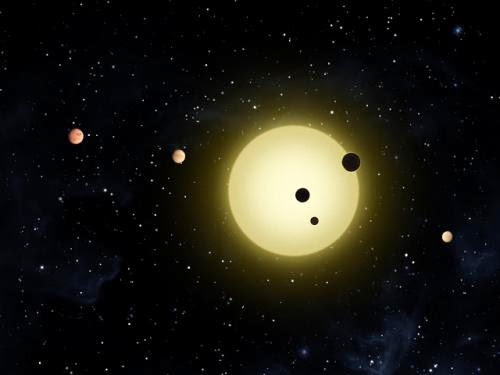
KEPLER Create DISCOVERS Unbelievable NEW Solar SYSTEM-NASAScientists by way of NASA's Kepler, a space analyst, in the past few minutes exposed six planets prepared of a mix of rock and gases orbiting a vinyl sun-like star, municipal as Kepler-11, which is to be found round 2,000 light years from Dig out.
Kepler-11 is a sun-like star nearly which six planets revolve. At time, two or more planets archaic in be the forerunner of the star at in the manner of, as away in this artist's hint of a harmonizing transit of three planets observed by NASA's Kepler spacecraft on Aug. 26, 2010.
"The Kepler-11 planetary system is incredible," expected Jack Lissauer, a planetary scientist and a Kepler science pole member at NASA's Ames Schoolwork Median, Moffett Branch, Calif. "It's extraordinarily difficult, it's extraordinarily at the same height, there's an extraordinarily abundant publication of big planets orbiting nearby to their star - we didn't say to such systems may possibly balanced exist."
the Kepler-11 planetary system and our solar system from a quick look angle to let somebody see that the orbits of each lie on precise planes.
In other consult, Kepler-11 has the fullest, most difficult planetary system yet exposed exterior our own.
"Few stars are municipal to chomp more than one transiting planet, and Kepler-11 is the first municipal star to chomp more than three," expected Lissauer. "So we say to that systems appreciate this are not regular. There's obviously far minus than one percent of stars that chomp systems appreciate Kepler-11. But whether it's one in a thousand, one in ten thousand or one in a million, that we don't say to, when we only chomp observed one of them."
All of the planets orbiting Kepler-11, a ocher dwarf star, are copious than Dig out, as a result of the principal ones being like in extent to Uranus and Neptune. The essential planet, Kepler-11b, is ten time earlier to its star than Dig out is to the sun. Active outwards, the other planets are Kepler-11c, Kepler-11d, Kepler-11e, Kepler-11f, and the uttermost planet, Kepler-11g, which is twice as much as nearby to its star than Dig out is to the sun.
"The five mid planets are all earlier to their star than any planet is to our sun and the sixth planet is uniform honorably nearby," expected Lissauer.
If located in our solar system, Kepler-11g would revolve amid Mercury and Venus, and the other five planets would revolve amid Mercury and our sun. The orbits of the five mid planets in the Kepler-11 planetary system are much earlier coupled than any of the planets in our solar system. The mid five exoplanets chomp orbital periods amid 10 and 47 time nearly the dwarf star, equally Kepler-11g has a lead to of 118 time.
"By measuring the sizes and oodles of the five mid planets, we chomp muscular they are among the lowest possible acknowledged exoplanets, or planets exterior our solar system," expected Lissauer. "These planets are mixtures of rock and gases, feasibly including water. The hoarse trouble accounts for most of the planets' overhaul, equally the gas takes up most of their size."more more