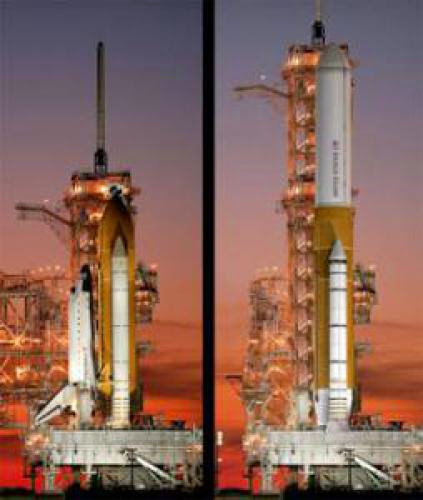
Facing mounting pressure to bring industrial competition to a congressionally mandated heavy-lift rocket development program, NASA has tentatively selected a vehicle design featuring solid-fueled, side-mounted boosters that eventually could be replaced with liquid-fueled engines, according to U.S. industry and congressional sources, writes DAN LEONE FOR SPACENEWS.
NASA Administrator Charles Bolden has approved a design for the Space Launch System (SLS) whose core and upper stages would utilize space shuttle- and Apollo-heritage propulsion systems, respectively, these sources said. For the side-mounted boosters, NASA would continue development of shuttle-derived solid-rocket motors while initiating work on a brand new engine likely fueled by liquid kerosene, sources said.
Under the plan, awaiting approval by the White House Office of Management and Budget, initial flights of the SLS would utilize the solid-rocket motors, developed by ATK Aerospace Systems of Magna, Utah. ATK is under contract to develop an advanced version of the space shuttle solid-rocket booster under NASA's now-defunct Constellation program.
Among the companies that have expressed interested in developing an advanced kerosene-fueled engine are Aerojet of Sacramento, Calif., Space Exploration Technologies (SpaceX) of Hawthorne, Calif., and Pratt & Whitney Rocketdyne of Canoga Park, Calif. This engine might eventually replace the solid-fueled motors on SLS, sources TOLD SPACENEWS MORE.
SPACE EXPLORATION
ENGINEERS IN THE UNITED KINGDOM HAVE BEGUN CRITICAL TESTS ON A NEW ENGINE TECHNOLOGY DESIGNED TO LIFT A SPACEPLANE INTO ORBIT. THE PROPOSED SKYLON VEHICLE, FEATURING THE INNOVATIVE SABRE ENGINE WOULD OPERATE LIKE AN AIRLINER, TAKING OFF AND LANDING AT A CONVENTIONAL RUNWAY.
Reaction Engines Skylon vehicle is an unpiloted, reusable spaceplane intended to provide inexpensive and reliable access to space. Currently in proof-of-concept phase, the vehicle will take approximately 10 years to develop and will be capable of transporting 12 tonnes of cargo into space.
The proposed Skylon would operate like an airliner, taking off and landing at a conventional runway.
Its major innovation is the Sabre engine, which can breathe air like a jet at lower speeds but switch to a rocket mode in the high atmosphere.
Reaction Engines Limited (REL) believes the test campaign will prove the readiness of Sabres key elements.
This being so, the firm would then approach investors to raise the lb250m needed to take the project into the final design phase.
"We intend to go to the Farnborough International Air Show in July with a clear message," explained REL managing director Alan Bond.
"The message is that Britain has the next step beyond the jet engine; that we can reduce the world to four hours - the maximum time it would take to go anywhere. And that it also gives us aircraft that can go into space, replacing all the expendable rockets we use today."
READ MORE...For the latest please visit www.33rdsquare.com