Since Scott Mardis was doing his comparisons with Plesiosaurs on Loch Ness Monsters and Lake Champlain Champs, I decided to do a few of the same with the Plesiosaurian Sea serpent Sighting sketch by L.S. Larkin from Ivan Sanderson's files to some of the standard sea-serpent sightings composites.
Oudemans' model from The Great Sea Serpent, 1892
The comparison to Oudemans' Sea Serpent from above and then a comparison to Sanderson's model in profile. Unfortunately, Sanderson does not provide a view from above for his composite. Except for the great length of tail allowed by Oudemans, the relative lengths of the head and neck, body and tail are all in the same general comparative proportions. The real differences are in the size and placement of the flippers and in the width of the body. Larkin seems to have exaggerated the relative widths of the neck and back to something approaching caricature. Below is the comparison to my composite model (Final composite, all Longneck sightings worldwide, final average statistics)
My composite has been run on this blog before, This time I chose to darken it in, but it seems to have made a problem with the photoshop. Nonetheless the results are similar: longitudinal measures are similar but Larkin has exaggerated his relative widths, and there is an ambiguity about the size and the placement of the limbs. Larkin says he had trouble making the limbs out because of the movement in the water. And because we have made note of another couple of particularly Plesiosaur-shaped Sea Serpents on this blog before, I reproduces them below for further comparison.
The Alvin (Submarine) one below differs somewhat in having a larger head and longer tail than usual, but these might only be false impressions due to poor viewing conditions. I do have one report of what sounds like a legitimate Plesiosaur-Sea-serpent corpse washed ashore and which was reported to me personally, and the witness said it looked like The Alvin Plesiosaur (Charles Berlitz got duplicate documents as stated on my copies)
Source: mysteries-and-strangeness.blogspot.com
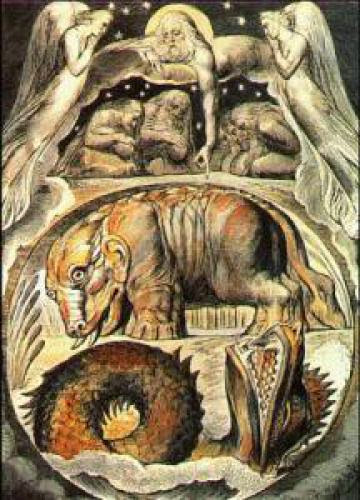
Behemoth (upper creature, depicted as a hipopotamus, its most popular mainstream identity among scholars - see my previous blog post) and Leviathan (lower creature) - illustration by William Blake
Over the years, there have been countless considerations of giant sea monsters, but what about the real, original leviathan? This colossal mystery beast of the Bible - "the piercing serpent...that crooked serpent...the dragon that is in the sea" (Isaiah, 27:1) - is, after all, the creature whose name has ultimately become an umbrella term for large, unidentified water beasts everywhere - as evinced by Tim Dinsdale's classic book on this subject, "The Leviathans" (1966, 1976).
The Old Testament contains four references to this monstrous sea creature, which provide several important morphological features - including its huge size, extensively scaled body, elongate shape, large plentiful teeth, shining eyes, powerful neck, smoking nostrils, and distinctive fins. Biblical scholars have nominated several different animals as the leviathan's identity, but whereas each possesses some of its characteristics, none has all of them.
The most popular identity is the Nile crocodile "Crocodylus niloticus", which is indeed scaly and somewhat elongate, with an abundance of large teeth, a powerful neck, shining eyes, and a sizeable (albeit not enormous) body. However, it possesses neither fins nor smoking nostrils, and is not marine in habitat. Sharks are marine and finned, some are very large and fairly elongate, and many have plenty of large teeth, but not smoking nostrils, shining eyes, or scales.
Whales are also marine, finned, often very large and quite streamlined, and some have many large teeth. Moreover, the spray spouted upwards from around their blow-holes when they exhale could conceivably be distorted into smoke during the telling and retelling of leviathan reports over successive generations - but whales are neither scaly nor shiny-eyed, and their necks are almost invisible.
And so it goes on - even identities as unlikely as the rock python "Python sebae" have been offered in a desperate attempt to reconcile this exceptional creature with a known type of animal.
Most probably, the leviathan is a non-existent composite, part-myth and part-reality. The latter component comprises a hotchpotch of distinctive features drawn from all of the animals noted above, and possibly one other too - a bona fide sea serpent.
On account of its scaly skin, veteran cryptozoologist Dr Bernard Heuvelmans considered the leviathan to be of the 'marine centipede' type. (Thus, according to his belief in what those creatures are, it would have been a modern-day armoured archaeocete - however, we nowadays know that such beasts never existed, as they were merely artefacts caused by archaeocete fossils being fiound in association with scales from other, unrelated creatures.) Conversely, I believe that if the leviathan is either a sea serpent or a myth inspired in part by sightings of one, then it is more likely to be a living mosasaur.
Mosasaur - could a modern-day species explain the leviathan? (Tim Morris)
Indeed, this identity uniquely combines all of the leviathan's features - its scaly body, elongate shape, shining eyes (typical of many large reptiles), powerful neck, fins, great size (as with the tylosaurs), large plentiful teeth, and smoking nostrils (as with the whale identity, no doubt a reference to the spouting of water displaced from around its nostrils when exhaling underwater). Yet only a complete specimen can conclusively test this hypothesis.
"Canst thou draw out leviathan with an hook?", asks Job (41:1). Judging from science's singular lack of success in securing the carcase of any type of genuine water monster via any of the traditional means utilised in capturing aquatic animals, the answer to this question would appear, quite definitely, to be no! Clearly, then, it is time to develop a different means of obtaining such evidence - one commensurate with the sophisticated technology now available for scientific research - for until such evidence is obtained, all of the leviathans documented by water monster chroniclers down through the ages will continue to remain an abiding mystery.
In 1886, Charles Gould passed the following remarks in his book "Mythical Monsters":
"Let the relations of the sea-serpent be what they may; let it be serpent, saurian, or fish, or some form intermediate to them; and even granting that those relations may never be determined, or only at some very distant date; yet, nevertheless, the creature must now be removed from the regions of myth, and credited with having a real existence, and that its name includes not one only, but probably several very distinct gigantic species, allied more or less closely, and constructed to dwell in the depths of the ocean, and which only occasionally exhibit themselves to a fortune-favoured wonder-gazing crew."
It is a sad reflection of zoology's longstanding disinterest in the subject of water monsters that those words are as relevant today as they were more than a century ago.
'Destruction of Leviathan' (Gustave Dor'e, 1865)
THIS IS AN EXCERPT FROM ONE OF MY BOOKS-IN-PROGRESS, "THE CREATURES THAT TIME FORGOT: STILL IN SEARCH OF PREHISTORIC SURVIVORS"
BASS RIVER TOWNSHIP, NJ, HISTORY...ETC.
"The following 1840 account, vouched for by William McCarty, a respected businessman of that era, has me wondering if there is some truth behind the old accounts of sea serpents in our area. William McCarty is clearly no crank. He built the iron making town of McCartyville just up the road a piece from New Gretna. After he went bankrupt, McCartyville became the paper town called Harrisville. Today, many local residents swim at Harrisville Lake where the ruins of the old Harrisville paper mill can still be seen."
http://bassriverhistory.blogspot.com/2012/03/sea-serpents-revisited.html [The above story posted on the local-History blog also linked to the next story. The next story was freshly priunted when I went in to the SITU Libraries in the 1970s: the SITU was in New jersey, and the news was both (by date of publication) fresh and of local interest then.-DD] http://bassriverhistory.blogspot.com/2011/07/rube-corlies-and-lock-ness-monster.html LITTLE DID I KNOW THAT IF I WANTED TO SEE A SEA MONSTER, I SHOULD HAVE SET MY SIGHTS TOWARD THE ATLANTIC OCEAN JUST OFF SURF CITY. IT SEEMS THAT RUBE CORLIES AND HIS BROTHER-IN-LAW, JONN INMAN, SPOTTED ONE WHILE FISHING FOR MENHADEN.
Rube Corlies in his yard in Manahawkin WATCH OUT FOR SEA SERPENTSIt doesn't happen very often. But every now and then people do run into sea monsters. They say one was sighted off Gloucester, Mass., in 1819. Another startled three fishermen near Kennebunk, Maine in 1830. And, of course, the monster of Loch Ness pops up from time to time.But did you know that one was seen off Long Beach Island ln 1906?A great snake rose out of the water early one July morning just off Surf City and appeared to eight men who had been fishing.Here's the story as told by Rube Corlies of Manahawkin. Corlies, a frail but Spunky 88 year old man, is the last survivor of the serpent sighting, "My brother-in-law John Inman and I had been catching mossbunkers using a 40-fathom net a couple of hundred yards off the beach. While we were hauling in the net, he remarked that the fish were behaving in a funny way- swimming crazily as if something was chasing them."Suddenly a great snake reared up about 15 to 20 feet out of the water maybe 30 or 40 feet from the stern of our boat. The animal was black on the back and had a lot of flabby white flesh on its belly. The mouth was about four feet wide and its nose was just like a snake's. He was slick as an eel and I couldn't see any scales or fins."We couldn't believe our eyes - there it was and there we were. lt seemed to stand straight up with its great black eyes turned toward us."Inman threw the net overboard and they started to row. The serpent sank back to the surface of the water."It started to come right at us, but it must have gotten all tangled up in our net - we found a huge hole in it later. As it swam past us on the surface it must have been about 60 feet long - not counting the tail and 6 feet wide."Men in three other fishing boats which were in the area saw that Corlies seemed to be in trouble and began to row toward him and as they did, the serpent surfaced again about a half mile away. This time it locked like a large tree trunk standing about 10 feet tall.Then it disappeared for good. And has never been seen again.Some people think Rube Corlies was dreaming that day back in 1906. Others wonder it he might have been drinking.But according to Corlies he had not had a drop ("Although if I had known what I was going to see that day, I might have drunk a bottle.") and he is certain of what he saw. "It was a giant sea snake and it must have been feeding on the mossbunkers."He goes on to say that he thinks the serpent may have come in shore because of a ship that had wrecked in 1900 on Long Beach Island. The ship had been carrying animal bones and when it was broke up the bones formed a slick which on certain tides extended out to sea. Corlies thinks this slick might have lured the fish which in turn lured the serpent."Anyway I know what I saw and that's all there ls to it. That big snake may still be out there some place. It was two weeks later because our nets looked like something very large had torn them."Would he like to see the monster again?"No," says Corlies with a mischievous grin, "but I was always disappointed I didn't see one other creature.I've anchored alongside whales and seen the serpent, but I never saw a mermaid. I guess they knew when l was coming out and they'd disappear."Well, you can't have everything.The Southern Ocean County Reporter - June 30, 1971
I'M THINKING OF CALLING MY MEN'S BREAKFAST BUDDY, JIM MCANNEY, WHO OWNS A BOAT, AND ASKING HIM TO TAKE ME ON A SEA MONSTER HUNTING EXPEDITION OFF SURF CITY. ANYONE OUT IN THE BLOG-O-SPHERE CARE TO JOIN US
PETE SPosted by Pete Stemmer, moderator at 8:33 PM
1 comment:
* July 31, 2011 at 9:16 PMMy name is Doug Lynch, and Rube Corlies was my Great-Great Uncle. When I was a youngster of around 6 or 7 years old, I remember Uncle Rube relating the sea serpent story to my brother and I many times while he taught us how to carve duck decoys in his old workshop on Stafford Avenue in Manahawkin. The one thing I can add that isn't mentioned in your article is that Uncle Rube said the serpent had eyes as big as "dinner plates". He was well known for being quite the storyteller. But it was also well known back in the day that my Great Grandfather, John Inman (who was with Rube at the time of the sighting), was "as honest as the day is long". He didn't drink or make up stories. Because of that, the sea serpent story was always believed to be true by the older members of my family. That's just my two cents, thanks for listening....
The size of the creature was no doubt exaggerated and the description had details that were traditional and probably legendary ("Eyes the size of dinner plates") Still it was a pretty obvious Longneck that had its head stuck "way" up when it surfaced. The colour of "Black" is not usually a precise description of colour and ordinarily comes from seeing the object on the shadow side. One interesting detail is that the front of the throat is all loose and flabby flesh (noted elsewhere before) The nose and the mouth was just like a snakes, and this is one case where the mouth split the head in half and the mouth was at full gape out of surprise or fear. The estimate of the mouth being open four feet wide (Top to bottom jaw at full gape) is close to what some of the officers claimed aboard the Daedalus when the rumours were circulating it opened its mouth six feet wide. This detail did not make it into the published newspaper accounts, but it is echoed elsewhere. Plesiosaurs did indeed have mouths which could open very wide in relation to the size of the head and this would resemble the open mouth of a snake, probably for a threat: a standard Longneck 40 feet long could probably open its mouth 4 feet wide up and down. The inside of the mouth is said to be bright red, enhancing the threat value (Also noticed at Loch Ness ) -DD
http://www.strangemag.com/seaserpgallery.html
THE SUWARROW ISLAND SEA SERPENT CARCASS
When the English trading steamer "Emu "was at Suwarrow Island (a Pacific sea island near Samoa) on her way to Sydney, Australia, they were told by natives that a huge "devil fish" had been beached. Mr. A. H. Bell, of the "Emu, "told of their search for the carcass, and of its horrible odor. "We secured as much of it as we could, and we have now on board the first sea serpent ever brought to Australia or anywhere else," Bell announced modestly. The "Emu "arrived in Sydney with a part of the creature. The monster was covered with hair and was brownish. According to the captain, the head was like that of a horse. He estimated the weight to be seventy tons and guessed that the creature was 60 ft. long. The skull alone was three feet long. "The English Mechanic", (No. 69, April 7, 1899, p. 17) noted that, "there was evidence of two tusks at the extremity of the lower jaw, and the natives said the monster had flappers like a seal when it was originally washed ashore." A scientist at the Australian Museum determined that the monster was actually a badly decomposed beaked whale. This would account for the two "tusks." A decomposed beaked whale is a monstrous thing, and resembles no earthly animal.
http://en.wikipedia.org/wiki/Beaked whale
The following is from a microfilm of a newspaper account of the find, unfortunately not very legible in part. The originating site prints a copy.
http://trove.nla.gov.au/ndp/del/article/68212949
THE SEA SERPENT.
FOUND AT LAST. BROUGHT TO SYDNEY.[Bv Elootrie Telegraph.]SYDNEY. February 22 1899.At last a sea serpent has been actually discovered and brought within range of scientific examination. The officers of the island steamer "Emu" have gained the credit for achieving this notable result. The vessel reached Sydney to-night-. Captain Oliver called at Suwerro on his way back, and the natives casually stated that a. big devil-devil from the sea came ashore two months before. The officers of the Emu went along (he beach, where they saw the gigantic monster. The stench was horrible, but the extraordinary appearance of the monster determined them to bring the remains to Sydney, thus securing the first sea serpent. The two heads, two backbones, and part of the ribs were all gathered. It is intended to present the skeleton to the Sydney Museum. Captain Oliver's account of the monster is that it has one body, but a double spine. It has two distinct heads; and a hide of a brownish colour covered with hair. The heads are somewhat like horses' heads. The length of the monster is fully 60 ft, and its approximate weight is seventy.tons. The visitors to the "Emu" to-day say the stench from the hold was [horrible]SYDNEY. February 23. The announcement of the discovery of the sea serpent has caused a great deal of interest Only a small portion of the skeleton was brought over to Sydney. It is intended OQ the next trip of the "Emu" to recover the whole of the bones. SO IT SEEMS THAT A NUMBER OF SMALLER BEAKED WHALES RAN AGROUND ON SUWARROW ISLAND IN POSSIBLY LATE 1898, A MASS STRANDING, AND THE NATIVES REPORTED IT AS IF IT HAD BEEN ONE ANIMAL. THE CAPTAIN ESTIMATED THE BIOMASS AS HAVING BEEN SEVENTY TONS IN LIFE, WHICH WOULD HAVE BEEN SEVERAL BEAKED WHALES TOGETHER, THE BIGGEST MALE AMONG THEM PROBABLY 35-40 FEET LONG WITH A 3 FOOT LONG SKULL, AND PROBABLY WEIGHING 15 TONS. USUALLY THE SMALL POD OF CLOSE-KNIT WHALES TOGETHER IS INTERPRETED AS A "MANY-FINNED" SEA-SERPENT AND SIGHTINGS OF THE GROUP OF WHALES IN THE WATER PROBABLY AIDED IN GIVING THE NATIVES THE IMPRESSION THERE WAS ONLY ONE LARGE "DEVIL-DEVIL"
"Poonah Many-Finned Sea-Serpent"
THE GENUINELY BIZARRE FEATURE IS THAT NOT ONLY WERE THE NATIVES STILL CONVINCED IT WAS ONLY ONE ANIMAL AFTER IT WASHED ASHORE, THEY WERE ABLE TO KEEP THE CAPTAIN AND CREW OF THE "EMU" CONVINCED OF THAT AS WELL, EVEN WHEN THEY BEGAN TO COLLECT MULTIPLE SKULLS AND SPINAL COLUMNS. THE ADVANCED STATE OF DECAY (WHICH PRODUCED THE "COCONUT HAIR" APPEARANCE FROM FRAYED SKIN AND MUSCLE FIBERS) PROBABLY MADE THAT SOMEHOW EASIER TO SWALLOW. THE KIND OF BEAKED WHALE WAS ONLY RECOGNIZED AS A SPECIES SHORTLY BEFORE AND THEREFORE THE CAPTAIN WAS ALMOST CORRECT IN HIS GUESS IT WAS AN UNKNOWN ANIMAL. BUT THE IDEA THAT SEVERAL SMALLER WHALE CARCASSES TOGETHER MADE UP ONE MONSTER CARCASS IS A FUNDAMENTAL ERROR IN JUDGEMENT THAT SEEMS DIFFICULT TO CREDIT.
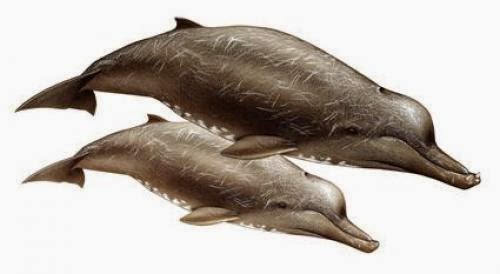
Scale Drawing of the Beaked Whale, from Wikipedia
Small pod of these whales in life.