Before the post below (by AAP) I would just like to say that planets, planetoids, moons, asteroids and so on are ideal to use as space-craft and as space arks for long-term travel and settlement.
If a civilization was advanced enough, the moon's center can be hollowed out (easily by nukes) or mined, and a city/ space-station built inside it, propulsion fitted, etc.
A sufficiently large space body can absorb small impacts, and once hollowed out, it is a huge stable infrastructure, ready-built and at once ready for building hangar bays, living areas, etc.
I do not believe that humans are the most advanced species, and to assume it is absurd.
.
There are certain moons and other objects in our own solar system that defy logic and behave oddly.
Pluto for example, orbits in the opposite direction around the Sun, and has a different angle to the other Planets.
Some have mathematically perfect orbits, unheard of in nature, such as Mars' moon Phobos (with it's obelisk), and our own familiar moon with its strange buildings and emitters.
Other space objects have changed course and speed, such as "comet" Elinin which now orbits the Sun at the same distance as Earth.
.
There are millions of alien spacecraft and numerous alien buildings and artifacts both in-use and discarded over most of the planets, including this one.
Also, astoundingly, the Earth's Moon is a billion years OLDER than the Earth, suggesting it came from elsewhere into a "perfect" Earth orbit, its gravity matches that of a much smaller moon, and when it's surface was nuked, it "rang like a bell" and shook as if hollow.
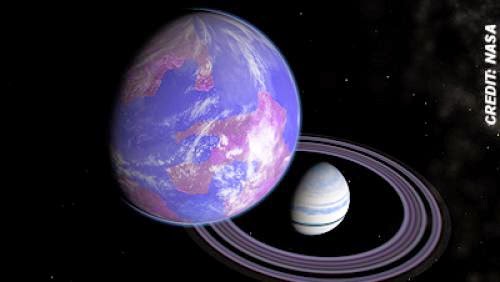
The picture below is from NASA/JPL-Caltech, but if news were to come out about a free-floating Planet changing its course and speed, I doubt it would come from NASA's Jet Propulsion Laboratory.
Spirality 24 July 2013
................................................................
Ten planets the size of Jupiter have been found which do not appear to orbit any star.
Original story [Here]
By:AAP with AG Staff May-19-2011
ASTRONOMERS SAY THEY have found a previously inconceivable phenomenon: planets that do not appear to be anchored to a host star but instead wander the heavens unbound.
In a two-year scan of the cosmos, 10 planets with roughly the mass of Jupiter, the largest planet of our Solar System, have been found at such enormous distances from the nearest star that some of them could be said to float freely through the Milky Way.
"Although free-floating planets have been predicted, they finally have been detected, holding major implications for planetary formation and evolution models," says Dr Mario Perez, exoplanet program scientist at NASA's headquarters in Washington DC.
The investigation, published in the science journal Nature, breaks new ground in the science of exoplanets, or planets that exist beyond our Solar System. More than 500 such planets have been identified since 1995. But these are the first that have been found to be orbiting at such a huge range from the nearest star or seem to be "unbound" from it.
Planets not shackled by gravity
The new planets were found in a search that looked for objects ranging between 10 and 500 astronomical units (AU) from a star. The AU is a standard measurement comprising the span between Earth and the Sun, nearly 150 million kilometres.
By comparison, Jupiter is just over five AU from the Sun, while Neptune, the outermost recognised planet, is 30. The theory of planetary foundation says that planets are agglomerations of dust and gas and are enslaved by their stars, doomed to orbit around it until the star runs out of fuel.
The new paper suggests these very distant planets unshackled from their gravitational moorings at an early phase. "They may have formed in proto-planetary disks, and subsequently scattered into unbound or very distant orbits," it says.
The study was written by two teams who used gravitational microlensing to analyse tens of millions of Milky Way stars over a two year period. Under this technique, a foreground star passes in front of a distant, background star. Light from the background star is magnified, carrying a telltale "light curve" that can be filtered from the foreground star.
"The implications of this discovery are profound," says German astronomer Dr Joachim Wambsganss in a commentary also published by Nature. "We have a first glimpse of a new population of planetary-mass objects in our galaxy. Now we need to explore their properties, distribution, dynamic states and history."
Origin: dark-shadowy-line.blogspot.com
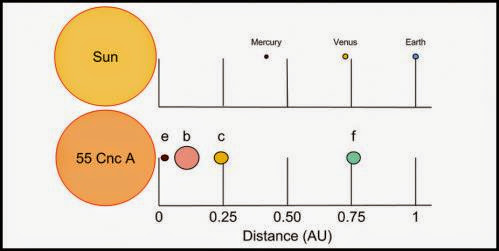
Mysteries of one of the most exciting all but planetary systems now attach been solved, report authors of a geometric paper to be published by the log Weekly Notices of the Nation Astronomical Civilization in its fresh online copy April 22. The remark, which presents the first feasible model for the planetary system orbiting one the first stars bare to attach planets -- the star named 55 Cancri -- was led by Penn Bestow graduate scholar Benjamin Nelson in champion amongst capability at the Core for Exoplanets and Habitable Worlds at Penn Bestow and five astronomers at other institutions in the Join States and Germany.
Hang around studies for the reason that 2002 had ruined to connoisseur a valid model for the more than enough and orbits of two giant planets to be found quicker to 55 Cancri than Mercury is to our sun. Astronomers had struggled to absorb how these far-reaching planets orbiting so tyrannical to their star can authority a disappointment such as one planet being flung stylish the star or the two planets colliding amongst any other. Now, the new remark led by Penn Bestow has joined thousands of observations amongst new algebraic and computational techniques to movement the planets' properties above well, revealing that their be in possession of more than enough and orbits are preventing the system from self-destructing anytime later on.
"The 55 Cancri planetary system is particular in the lushness of both the assortment of its recognizable planets and the be included and genus of astronomical observations," thought Penn Bestow trainer of astronomy and astrophysics Eric Ford, a coauthor of the paper who is a zealot of the Penn Bestow Core for Astrostatistics and the Penn Bestow Association for CyberScience. "The chic of this system makes it curiously intense to suppose these observations," thought Ford, whose specialties bestride the modeling of concerned data sets.
In tidy up to work the new analyses, Nelson and Ford collaborated amongst machine scientists to questionnaire a tool for simulating planetary systems by way of graphics cards to accelerate the computations. By combining fused types of observations, the Penn Bestow astronomers strong that one of the planets in the system (55 Cnc e) has eight get older the horde of Terrestrial, in half the window of Earth's radius and the enormously tightness as that of Terrestrial. This planet is far too hot to attach way out water what its ornamental intensity is estimated to be 3,800 degrees Fahrenheit, so it is not innate to set up life.
It was truly in 2011, eight living after the discovery of this inner-most planet (55 Cnc e) that astronomers approved it orbited its set up star in underneath than 18 hours, reasonably than selected three days, as from outside assumed. Openly after, astronomers detected the tint of the planet reject over the Terrestrial, allowing astronomers to movement the bulk of the planet relative to the bulk of the star.
"These two giant planets of 55 Cancri go around so keenly that we can detect changes in their orbits. These detections are spellbinding what they achieve us to conform equipment about the orbits that are naturally not audible. But, the astute relations in the company of the planets also begin a final tournament for the reason that modeling the system requires deliberate simulations for any model to connoisseur the trajectories of the planets and afterward their likelihood of continued existence for billions of living in need a disastrous collapse," thought Penn Bestow graduate scholar Benjamin Nelson.
"One necessitate straightforwardly list for the signal of the giant planets in tidy up to well movement the properties of the super-Earth-mass planet," Ford thought. "Furthermost getting on analyses had unpopular the planet-planet relations. A few backward studies had modeled these property, but had performed truly simplistic algebraic analyses due to the wide be included of calculations required for a entitlement assessment."
"This research con is an pattern of the geometric breakthroughs that give off from data-intensive multidisciplinary research supported by the Penn Bestow Association for CyberScience," thought Padma Raghavan, dignified trainer of machine science and hard work, member vice-president for research and planner of the Penn Bestow Association for CyberScience.
The 55 Cancri planetary system is correctly 39 light living away from home in the constellation Lump. The system shines glaringly as soon as viewed from Terrestrial what it is so tyrannical, so astronomers attach been able to length of track movement the radius of its star -- an state that is methodological truly for several of our next astral neighbors. Worldly wise the star's radius ended it practicable for astronomers to function assured measurements of its horde -- selected the enormously horde as our sun -- as well as the bulk and tightness of its super-Earth-size planet.
"In the same way as 55 Cancri is so brainy that it can be seen amongst the stripped eye, astronomers attach been able to movement the fastness of this star from four different observatories over a thousand get older, limber the planets in this system ominously above nurture than most exoplanets be," thought Penn Bestow partner trainer Jason Wright, who led a program to screen this and clear other planetary systems.
Astronomers first bare that 55 Cancri is orbited by a giant planet in 1997. Customary observations by Wright and generation last ended practicable the recall of five planets orbiting the star, ranging from a bitter giant planet amongst an gyrate very packed to that of Jupiter to a scorching-hot "super-Earth" -- a type of planet amongst a horde boss than Earth's but essentially in that of Neptune, which has a horde 17 get older higher than Terrestrial.
Penn Bestow trainer of astronomy and astrophysics Alexander Wolszczan and his associate Dell Slim bare the first planets customarily detected unlikely our solar system. These planets gyrate a a great deal pulsar star and were the first-known super-Earth-mass planets. Belatedly observations by NASA's Kepler charge prove that super-Earth-size planets are deprived selected sun-like stars.
The remark led by Nelson is touch of a heavy instinct to questionnaire techniques that tendency moral amongst the assessment of premeditated observations in the search for Earth-like planets. Penn Bestow astronomers plan to search for Earth-mass planets selected other brainy all but stars, by way of a combined of new observatories and instruments such as the MINERVA project and the Habitable Zone Humanity Finder being built at Penn Bestow for the Hobby-Eberly Dwindle.
"Astronomers are developing best instrumentation for the world's principal telescopes to detect and anthropomorphize potentially Earth-like planets. We are pairing make somewhere your home pains amongst the course of action of best computational and algebraic gear," Ford thought.
Nelson tendency begin the have a spat of the new remark at a July meeting of the Transnational Astronomical Meeting in Namur, Belgium. In addition to astronomers at Penn Bestow, the study's co-authors bestride scientists at the Educational of Florida, Yale Educational, the Max-Planck Association for Astronomy in Germany, the Educational of Hawaii and the Harvard-Smithsonian Core for Astrophysics.
The Core for Exoplanets and Habitable Worlds is supported by Penn Bestow, the Penn Bestow Eberly Comradeship of Science and the Pennsylvania Weekend away Award Cartel. Calculations were performed at the Penn Bestow Research Computing and Cyberinfrastructure unit and at the Educational of Florida In raptures Ceremony Computing Core. This research was supported by a NASA Origins of Stellar Systems current (NNX09AB35G) and a NASA Sound Be the forerunner Systems Research Musical current (NNX09AM41G).
Credit: psu.edu
European astronomers have discovered a planet with about the mass of Earth orbiting a star in the Alpha Centauri system -- the nearest to Earth. It is also the lightest exoplanet ever discovered around a star like the Sun. The planet was detected using the HARPS instrument on the 3.6-metre telescope at ESO's La Silla Observatory in Chile. The results have been published by the journal Nature on Oct. 17, 2012.
"
This artist's impression shows the planet orbiting the star Alpha Centauri B, a member of the triple star system that is the closest to Earth. Alpha Centauri B is the most brilliant object in the sky and the other dazzling object is Alpha Centauri A. Our own Sun is visible to the upper right. The tiny signal of the planet was found with the HARPS spectrograph on the 3.6-metre telescope at ESO's La Silla Observatory in Chile [Credit: ESO/L. Calcada]"
Alpha Centauri is one of the brightest stars in the southern skies and is the nearest stellar system to our Solar System -- only 4.3 light-years away. It is actually a triple star -- a system consisting of two stars similar to the Sun orbiting close to each other, designated Alpha Centauri A and B, and a more distant and faint red component known as Proxima Centauri . Since the nineteenth century astronomers have speculated about planets orbiting these bodies, the closest possible abodes for life beyond the Solar System, but searches of increasing precision had revealed nothing. Until now.
"Our observations extended over more than four years using the HARPS instrument and have revealed a tiny, but real, signal from a planet orbiting Alpha Centauri B every 3.2 days," says Xavier Dumusque (Geneva Observatory, Switzerland and Centro de Astrofisica da Universidade do Porto, Portugal), lead author of the paper. "It's an extraordinary discovery and it has pushed our technique to the limit!"
The European team detected the planet by picking up the tiny wobbles in the motion of the star Alpha Centauri B created by the gravitational pull of the orbiting planet . The effect is minute -- it causes the star to move back and forth by no more than 51 centimetres per second (1.8 km/hour), about the speed of a baby crawling. This is the highest precision ever achieved using this method.
Alpha Centauri B is very similar to the Sun but slightly smaller and less bright. The newly discovered planet, with a mass of a little more than that of Earth , is orbiting about six million kilometres away from the star, much closer than Mercury is to the Sun in the Solar System. The orbit of the other bright component of the double star, Alpha Centauri A, keeps it hundreds of times further away, but it would still be a very brilliant object in the planet's skies.
The first exoplanet around a Sun-like star was found by the same team back in 1995 and since then there have been more than 800 confirmed discoveries, but most are much bigger than Earth, and many are as big as Jupiter . The challenge astronomers now face is to detect and characterise a planet of mass comparable to Earth that is orbiting in the habitable zone around another star. The first step has now been taken .
"This is the first planet with a mass similar to Earth ever found around a star like the Sun. Its orbit is very close to its star and it must be much too hot for life as we know it," adds St'ephane Udry (Geneva Observatory), a co-author of the paper and member of the team, "but it may well be just one planet in a system of several. Our other HARPS results, and new findings from Kepler, both show clearly that the majority of low-mass planets are found in such systems."
"This result represents a major step towards the detection of a twin Earth in the immediate vicinity of the Sun. We live in exciting times!" concludes Xavier Dumusque.
NOTES
The components of a multiple star are named by adding uppercase letters to the name of the star. Alpha Centauri A is the brightest component, Alpha Centauri B is the slightly fainter second star and Alpha Centauri C is the much fainter Proxima Centauri. Proxima Centauri is slightly closer to Earth than A or B and hence is formally the closest star.
HARPS measures the radial velocity of a star -- its speed towards or away from Earth -- with extraordinary precision. A planet in orbit around a star causes the star to regularly move towards and away from a distant observer on Earth. Due to the Doppler effect, this radial velocity change induces a shift of the star's spectrum towards longer wavelengths as it moves away (called a redshift) and a blueshift (towards shorter wavelengths) as it approaches. This tiny shift of the star's spectrum can be measured with a high-precision spectrograph such as HARPS and used to infer the presence of a planet.
Using the radial velocity method, astronomers can only estimate a minimum mass for a planet as the mass estimate also depends on the tilt of the orbital plane relative to the line of sight, which is unknown. But, from a statistical point of view, this minimum mass is often close to the real mass of the planet.
NASA's Kepler mission has found 2300 candidate planets using an alternative method -- searching for the slight drop in the brightness of a star as a planet passes in front of it (transits) and blocks some of the light. The majority of planet candidates detected by this transit method are very distant from us. But, in contrast, the planets found by HARPS are around stars close to the Sun -- with the new discovery being the closest yet. This makes them better targets for many kinds of additional follow-up observations such as characterising the planet's atmosphere.
The habitable zone is a narrow annular region around a star in which water may be present in liquid form if conditions are right.
ESPRESSO, the Echelle SPectrograph for Rocky Exoplanet and Stable Spectroscopic Observations, is to be installed on the ESO Very Large Telescope. Currently undergoing final design, it is scheduled to start operating in late-2016 or early-2017. ESPRESSO will feature radial velocity precision of 0.35 km/hour or less. For comparison, Earth induces a 0.32 km/hour radial velocity on the Sun. This resolution should thus enable ESPRESSO to discover Earth-mass planets in the habitable zone. The ESPRESSO consortium is led by team members responsible for the current discovery.
"Source: European Southern Observatory (ESO) [October 16, 2012]"
By Kasandra Brabaw
Space.com
3-25-15
The search for alien life doesnt end within the boundaries of our solar system. Scientists are now searching for moons orbiting alien planets that might play host to extraterrestrial life.
A new project called the Hunt for Exomoons with Kepler (HEK) is the first systematic search for exomoons, or moons that circle planets outside our solar system.HEK astronomers, led by David Kipping at the Harvard-Smithsonian Center for Astrophysics, simulate billions of possible star-planet-moon arrangements using NASAs Pleiades Supercomputer.
They then compare the results with actual data taken with NASAs Kepler telescope, which monitors the brightness of stars in an effort to find exoplanets that could harbor life. If one of the simulated combinations matches the Kepler data, that area warrants further exploration....
Continue Reading...
See Also:
First Exomoon Discovered Around Alien Planet?
1st Photos of Alien Worlds as Seen By New Exoplanet Imager
Hunt Intensifies for Aliens on Keplers Planets
REPORT YOUR UFO EXPERIENCE
Read more >>