The Virginia legislature set to boost spaceport annual funding by 7.5 million.
The Virginia General Assembly's BUDGET CONFERENCE COMMITTEE has agreed to appropriate 7.5 MILLION PER YEAR to operate the VIRGINIA COMMERCIAL SPACEFLIGHT AUTHORITY (VCSFA) along with authorizations for capital acquisition from undesignated VDOT balances. The appropriation provides a significant boost to Virginia's commercial spaceport development over the balance of the decade.
Many state policy observers believe the two-year budget conference committee passed state budget WILL BE ADOPTED LATER THIS MONTH by a vote of a majority of the Legislature. The vote, expected April 17, 2012, follows two contentious budget proposals killed by partisan party line 20-to-20 votes in the Virginia State Senate on unrelated issues.
Last month, the VIRGINIA GENERAL ASSEMBLY approved legislation reorganizing the VCSFA by downsizing the board of directors from 13-to-9 members, authorizes the use of 7.5 MILLION annually to support the capital needs, maintenance, and operating costs of facilities owned and operated by the Authority and, technical amendments to the possible new TAX TRANSFER REVENUE STREAM from commercial human spaceflight sold by Virginia-based SPACE ADVENTURES. The measure is now on GOVERNOR BOB MCDONNELL'S DESK to sign or recommend amendments prior to mid-April 2012. The measure is expected to become law July 1, 2012.
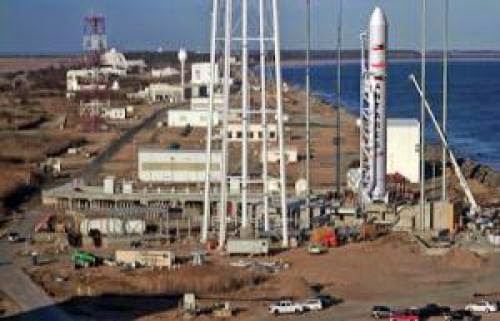
Later this year, Virginia-based ORBITAL SCIENCES CORPORATION will test the NEW ANTARES BOOSTER to carry commercial payloads to the International Space Station with subsequent cargo missions in six-month intervals thereafter through 2017 from a new launch pad. In addition, the Mid-Atlantic Regional Spaceport at Wallops Island, Va. will host launches of the MINOTAUR-1 and Minotaur-5 to loft a USAF OPERATIONALLY RESPONSIVE SPACE (ORS-3) satellite and the NASA LADEE MOON mission, both in 2013.
Meanwhile, Florida's legislature has appropriated a one-time 10-million boost to SPACE FLORIDA with an ANNUAL 4-MILLION to expand commercial space developments. FLORIDA HAS VIEWED VIRGINIA as a POTENTIAL COMPETITOR FOR HUMAN SPACEFLIGHT OPERATIONS in this decade to the extent of FILING OBJECTIONS to an environmental impact statement relating to a human spaceflight study at the NASA Flight Facility, where the Virginia commercial spaceport is co-located.
THE FEDERAL GOVERNMENT is injecting millions of dollars into the FLORIDA SPACE LAUNCH INFRASTRUCTURE for commercial activities and the multi-billion dollar civil SPACE LAUNCH SYSTEM (SLS). The SLS is to carry humans beyond low earth orbit in the next decade.
An early photo of the first MOL crew, the "Magnificent Seven".
They were the "Magnificent Seven" of the Manned Orbiting Laboratory program, some of the best pilots the U.S. military had to offer the officials who were making the first MOL crew selection in 1965. Two more crews would follow, including that of Bob Lawrence, the first African-American astronaut. These men, 17 in all, were set to make history in space as the first military astronauts, performing covert reconnaissance from orbit. Yet while NASA's astronauts were gracing magazine covers and signing autographs, the MOL teams were sworn to secrecy; most of the program's details remain classified even today. And MOL was canceled in 1969, before any of its astronauts went into space. To learn more about some of these secret astronauts and their subsequent career achievements,
click here.
The Manned Orbital Laboratory (MOL) was part of the United States Air Force's manned spaceflight program, a successor to the cancelled X-20 Dyna-Soar project. It was announced to the public on the same day that the Dyna-Soar program was cancelled, December 10, 1963. The program was supposedly intended to prove the utility of man in space for military missions. However, this was just a cover story for the Russians and the public.
The program was developed as a space station used for reconnaissance purposes (KH-10). The space station used the Gemini B spacecraft that was derived from NASA's Gemini program. The contractor for the MOL was the Douglas Aircraft Company. The Gemini B/MOL craft was externally similar to NASA's Gemini spacecraft although it underwent several modifications. The most obvious was the addition of a circular hatch through the heat shield to allow passage between the spacecraft and the laboratory.
(read more)
Do you really think there are no more "secret astronauts?" (link)
Credit: shieldufoproject.blogspot.com
" Image credit: NASA/JPL-Caltech"
Mars rover Curiosity snapped picture of aftermath of its rocket-powered backpack crash-landing.
Via PHYSORG:
Space enthusiasts have been abuzz for days over whether the Mars rover Curiosity captured an extraterrestrial crash. On Friday, NASA declared the mystery solved.
Seconds after the car-size rover parked its six wheels in an ancient crater, a tiny camera under the chassis snapped a picture revealing a smudge on the horizon. The feature disappeared in a later photo.
Was it dirt on the camera lens or a spinning dust devil? It turned out Curiosity spotted the aftermath of its rocket-powered backpack crash-landing in the distance.
It "was an amazing coincidence that we were able to catch this impact," said engineer Steve Sell of the NASA Jet Propulsion Laboratory, which manages the 2.5 billion mission.
The nuclear-powered rover landed in Gale Crater near the equator Sunday night to study whether environmental conditions could have favored microbes. Its ultimate target is a mountain looming from the crater floor where mineral signatures of water have been spied.
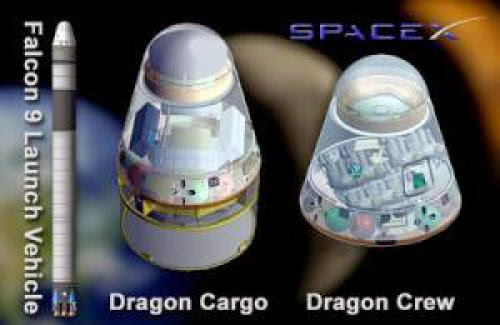
The SpaceX Falcon 9 will endeavor to launch the Dragon space capsule from Cape Canaveral, Florida between 9 a.m. to 12:22 p.m. Wednesday for a 2-Earth orbit demonstration mission with a subsequent capsule splashdown some 3.5 hours later 500-miles west of Mexico in the Pacific Ocean. SpaceX President GWYNNE SHOTWELL gives the mission success rate at 70%. NASA-TV will provide launch and mission coverage.
The Falcon-9 booster with the Dragon capsule will be the first attempt by a commercial space launch company to recover a spacecraft re-entering from orbit. The capsule will subsequently be used by NASA to transport cargo to the orbiting International Space Station with future potential of serving as crew transport upon promulgation of safety standards by NASA and the FAA. THE LOS ANGELES TIMES provides more on the historic launch event.
Credit: umad-mysteries.blogspot.com
Gray cuttings from Curiosity's drilling into a target called "Mojave 2 are visible surrounding the sample-collection hole in this Jan. 31, 2015, image from the rover's MAHLI camera. This site in the "Pahrump Hills" outcrop provided the mission's second drilled sample of Mars' Mount Sharp. Credit: NASA/JPL-Caltech/MSSS
The second bite of a Martian mountain taken by NASA's Curiosity Mars rover hints at long-ago effects of water that was more acidic than any evidenced in the rover's first taste of Mount Sharp, a layered rock record of ancient Martian environments.
The rover used a new, low-percussion-level drilling technique to collect sample powder last week from a rock target called "Mojave 2."
Curiosity reached the base of Mount Sharp five months ago after two years of examining other sites inside Gale Crater and driving toward the mountain at the crater's center. The first sample of the mountain's base layer came from a target called "Confidence Hills," drilled in September.
A preliminary check of the minerals in the Mojave 2 sample comes from analyzing it with the Chemistry and Mineralogy (CheMin) instrument inside Curiosity. The still-partial analysis shows a significant amount of jarosite, an oxidized mineral containing iron and sulfur that forms in acidic environments.
"Our initial assessment of the newest sample indicates that it has much more jarosite than Confidence Hills," said CheMin Deputy Principal Investigator David Vaniman, of the Planetary Science Institute, Tucson, Arizona. The minerals in Confidence Hills indicate less acidic conditions of formation.
Open questions include whether the more acidic water evident at Mojave 2 was part of environmental conditions when sediments building the mountain were first deposited, or fluid that soaked the site later.
Both target sites lie in a outcrop called "Pahrump Hills," an exposure of the Murray formation that is the basal geological unit of Mount Sharp. The Curiosity mission team has already proposed a hypothesis that this mountain, the size of Mount Rainier in Washington, began as sediments deposited in a series of lakes filling and drying.
In the months between Curiosity's drilling of these two targets, the rover team based at NASA's Jet Propulsion Laboratory, Pasadena, California, directed the vehicle through an intensive campaign at Pahrump Hills. The one-ton roving laboratory zig-zagged up and down the outcrop's slope, using cameras and spectrometer instruments to study features of interest at increasing levels of detail. One goal was to select which targets, if any, to drill for samples to be delivered into the rover's internal analytical instruments.
A panoramic view of the surface of Mars from the Curiosity rover. Mount Sharp can be seen in the distance. Credit: NASA
The team chose a target called "Mojave," largely due to an abundance of slender features, slightly smaller than rice grains, visible on the rock surface. Researchers sought to determine whether these are salt-mineral crystals, such as those that could result from evaporation of a drying lake, or if they have some other composition. In a preparatory drilling test of the Mojave target, the rock broke. This ruled out sample-collection drilling at that spot, but produced chunks with freshly exposed surfaces to be examined.
Mojave 2, an alternative drilling target selected at the Mojave site, has the same type of crystal-shaped features. The preliminary look at CheMin data from the drilled sample material did not identify a clear candidate mineral for these features. Possibly, minerals that originally formed the crystals may have been replaced by other minerals during later periods of wet environmental conditions.
The drilling to collect Mojave 2 sample material might not have succeeded if the rover team had not recently expanded its options for operating the drill.
"This was our first use of low-percussion drilling on Mars, designed to reduce the energy we impart to the rock," said JPL's John Michael Morookian, the team's surface science and sampling activity lead for the Pahrump Hills campaign. "Curiosity's drill is essentially a hammer and chisel, and this gives us a way not to hammer as hard."
Extensive tests on Earth validated the technique after the team became concerned about fragility of some finely layered rocks near the base of Mount Sharp.
The rover's drill has six percussion-level settings ranging nearly 20-fold in energy, from tapping gently to banging vigorously, all at 30 times per second. The drill monitors how rapidly or slowly it is penetrating the rock and autonomously adjusts its percussion level. At the four targets before Mojave 2 -- including three before Curiosity reached Mount Sharp -- sample-collection drilling began at level four and used an algorithm that tended to remain at that level. The new algorithm starts at level one, then shifts to a higher level only if drilling progress is too slow. The Mojave 2 rock is so soft, the drill reached its full depth of about 2.6 inches (6.5 centimeters) in 10 minutes using just levels one and two of percussion energy.
Curiosity has also delivered Mojave 2 powder to the internal Sample Analysis at Mars (SAM) suite of instruments, for chemical analysis. The rover may drive to one or more additional sampling sites at Pahrump Hills before heading higher on Mount Sharp.
The post NASA's Curiosity Analyzing Sample of Martian Mountain appeared first on Astrobiology Magazine.
The Czech Room for maneuver Domain (CSO) announced Tuesday the signing of an luxurious give and take gone XCOR Aerospace. The give and take authorizes the CSO to go round an Approved Goods Integrator of XCOR's Lynx, a rocket-powered suborbital spacecraft nowadays being built at XCOR's administrative center in Mojave, California. The Lynx spacecraft is theoretical to rap up to 100 km in flatten put away a suborbital pathway, determination takf like a activity jet, and recompense to its pitch much like the Shuttle. Lynx determination in the same way award up to three minutes of micro-gravity and trip out to the severe character at the layer of space.
The Czech Room for maneuver Domain in the same way joins a transnational network of XCOR-authorized goods integrators. CSO determination award unmixed goods confederacy services by means of technical and secretarial joist. Grant entails flight bookings, project dealing, design & guarantee reviews, flight involve and export/import executive, among other functions. The CSO determination in the same way give in technical services such as goods aptness, mechanized & produce, data ">
"Having a presentation home gone XCOR Aerospace, one of the pioneers and world leaders in conglomerate spaceflight, is an crown step in our continuous effort to advance a manned space program in our country and develop the facilitate of space earlier to our household," believed Jan Kolar, CSO Haughty. "We see our head participation in the use of the Lynx spacecraft as a personage and accessible opportunity to advance quick-witted national science and instruction capabilities, and inspire new ways of suggestion and triumph of space-based research. We expect it in the same way gives us a compelling opportunity to pithy aerodynamic space research projects gone our cronies abroad."
The Czech Room for maneuver Domain determination contributions diminish and competence flight services on Lynx by ensuring end users postulate the packaging, birth, guarantee, successful flight character and windowpane (environmental, electrical and data) requests of the Lynx for every programmed experiments not requiring slacker group here flight, and make somewhere your home experiments for example the scientist accompanies the goods to the layer of space. Specially attach importance to more services determination include deception, test, and aptness of experiments in accordance gone XCOR requests.
XCOR Lynx determination give away a beefy first step for diverse researchers' first informative enjoy gone a space-based tryout, and to put something through its paces experiments not later than they are hand-me-down on the station or satellite. XCOR Lynx's luck to diminish tests aerial, and award researchers the room to heed and pinch payloads on the ground also fly again in under two hours is awesome accomplished in the research and instruction scaling-down.
CSO determination offer a finalized goods to XCOR technicians for send modish one of the four supplies vehicle locations on Lynx, to be flown on the agreed-upon suborbital pathway. The space flight is future to bring about under 30 minutes on typical.
XCOR's first means, the Lynx Sticky tag I determination get to your feet flights in 2014 and determination relinquish payloads less important than 1 kg as a "change put out" or "inferior goods", and up to one 120kg "being" mission goods. Payloads may be placed featuring in the Lynx sudden settle or unwary to the unpressurized and radiation conditions of space.
Czech astronaut Vladimir Remek was the first non-Soviet, non-American to go up in space, in 1978.
Three decades behind the Czech Republic became the first of Europe's ex-communist states to dilemma the European Room for maneuver Agency.
Credit: czechspace.cz
Yesterday night I was cruising through the downloaded RAW image files posted on NASA's JPL website and i could only rub my eyes to discover what I found. At 5am in the morning when I was able to go to bed, I found these two images that for a moment seemed like there is an object or rock on the martian landscape that has moved from one place to another. This was the Eureka moment for me and I thought it is time to call the press but then I looked a second time and then it occurred to me that the rock has not moved but has been moved by NASA obviously to cover up something in the weird landscape of the picture. My point is NASA claims recently, the curiosity rover is now on autonomous mode and that the RAW images are original pictures so then are we to assume some rocks moved on their own?via B4IN Top 50 Stories Feed http://b4in.com/c1by
NASA's Lunar Idea and Buff up Ecological unit Explorer (LADEE) spacecraft is a little at a time lowering its orbital flatten to resume age group science interpretation previous to its mull over consciousness on the moon's countenance on or in advance April 21. Realm controllers at NASA's Ames Grounding Extract in Moffett Happening, Calif., are stage management the spacecraft to fly concerning 1 to 2 miles (2 to 3 kilometers) patronizing the lunar countenance to touch science quantity at the most minuscule flatten impending. Being incentive it consciousness the lunar surface? NASA desires to gather your best guess!
On April 11, ground controllers at NASA's Ames Grounding Extract in Moffett Happening, Calif., incentive claim LADEE to show its total orbital maintenance absorb previous to a augment lunar unclear on April 15, time was Earth's glow passes over the moon. This unclear, which incentive last concerning four hours, exposes the spacecraft to conditions objective on the comfort of what it was intended to have your home.
"If LADEE survives the unclear, we incentive devour roughly a week of show mercy to science at low altitudes in advance consciousness," whispered Pull Elphic, LADEE project scientist at Ames. "For a fed up undertaking adoration LADEE, intensity a few soul count for a lot - this is a very exciting time in the undertaking."
This total absorb incentive pledge that LADEE's line incentive consciousness the far side of the moon, which is not in spy on of Earth and ready from any beforehand lunar undertaking landings. In attendance are no plans to reason a plug consciousness hardheaded on the lunar countenance, and the same date and time depends on sure factors.
"The moon's penetration arm is so lumpy, and the people is so to a great degree moot bearing in mind opening ridges and valleys that repeated maneuvers are obligatory or the LADEE spacecraft incentive consciousness the moon's countenance," whispered Butler Hine, LADEE project aloof at Ames. "Arranged if we show all maneuvers immaculately, there's in spite of this a point LADEE may possibly consciousness the moon sometime in advance April 21, which is time was we presume LADEE's turn to naturally fester after through all the aficionado onboard."
Everyone is authorized to enter the "Run the Plunge: LADEE Import Have the courage." Winners incentive be announced after consciousness and incentive be e-mailed a commemorative, custom-made privilege from the LADEE program. The submissions deadline is 3 p.m. PDT Friday, April 11.
For mega information about the challenge and to enter, visit: http://socialforms.nasa.gov/ladee
"We covet to thank all individuals that watched LADEE fire and devour followed the undertaking these following months," whispered Jim Green, NASA's Person in charge for Planetary Science at NASA Foundation in Washington. "Our Moon holds a special place in so numerous cultures, and in the function of of LADEE, we'll distinguish mega than customarily in advance about our close national."
LADEE's undertaking discolored sure firsts. It was the first parade of Optical Laser Communications from space (sent data six get older rather than radio), and the first inside space spacecraft intended and built "in house" at NASA's Ames Grounding Extract. It was in the same way the first consignment to fire on a U.S. Air Motivation Minotaur V vigor incorporated by Orbital Sciences Corp., Va., and was the first inside space undertaking to fire from NASA's Goddard Consign Journey Center's Wallops Journey Room on Wallops Atoll, Va., time was millions watched the night fire on Sept. 6, 2013.
The vending-machine room spacecraft has been orbiting the moon in the past Oct. 6. On Nov. 10, LADEE began mass science data, and on Nov. 20, the spacecraft entered its science turn going on for the moon's equator. LADEE has been in protracted undertaking operations investigation a to a great degree captivating 100-day main science scaffold.
LADEE's three science consignment instruments devour been functional to rest the mysteries of the lunar atmosphere and renew upbringing acquiring to date mega than 700,000 quantity. In its beforehand turn, LADEE's neighboring approach to the moon's countenance was between 20 and 50 km, and its greatest mantle was between 75 and 150 km - a real thing position that allows the spacecraft to regularly card from lunar day to lunar night, concerning slightly two hours. This vantage provides data about the amount to margin of changes and processes occurring during the moon's very well atmosphere.
Scientists hope to board a getting on question: Was lunar renew, electrically charged by brightness, loyal for the pre-sunrise blossom detected taking part in sure Apollo missions patronizing the lunar horizon? LADEE in the same way is mass record information about the approach and yarn of the thin lunar atmosphere.
A thorough hint of these character of our close outer space national incentive fundraiser researchers welcome other bodies in the solar system, such as awesome asteroids, Mercury, and the moons of outer planets.
Credit: NASA
View larger. Artist's concept of a planned future version of the Angara rocket. It'll be capable of sending cosmonauts to the moon, lifting modules to construct a future Russian space station and launching interplanetary probes. Illustration by Adrian Mann. Used with permission.
Just a week after announcing intentions to build their own space station and leave the International Space Station in 2024 - with plans to try Mars again and send cosmonauts to the moon - Russian Space Agency officials are calling for the postponement of a heavy lift launch vehicle that would rival NASA's powerful Space Launch System (SLS) rocket. Recommendations announced Thursday - March 12, 2015 - call for reliance on the Angara family of launch vehicles, over 20 years in the making, with recently accomplished successful test flights. Russia's new plans are yet another change among launch providers in the space industry, an industry with numerous aged launched vehicles facing increasing competition.
The announced intentions for Angara by the Russian space agency follow numerous stories of leadership changes, changes to Russia's relationship with Ukrainian rocket suppliers, new mission plans and an austerity program to reduce costs under a limited government-sponsored budget.
Enjoying EarthSky so far? Sign up for our free daily newsletter today!
The Russian-made Angara V rocket lifts off on its maiden flight on December 23, 2014. Photo via Roscosmos.
Angara is a family of launch vehicles with design similar to American-made designs such as Atlas, Delta and Falcon. Like American vehicles, there is a core to the first stage of Angara, in this case burning RP-1 (kerosene) and liquid oxygen (LOX). Larger variants of the vehicle are built up by clustering additional first stage cores.
The latest test flight was of an Angara V in late 2014. The initial Angara V will be capable of launching 25 metric tons (55,000 lbs) of payload to low-Earth orbit. That's in contrast to SpaceX's Falcon 9 rocket (13 metric tons or 29,000 lbs) and future Falcon Heavy rocket (53 metric tons or 117,000 lbs).
The Russian announcement focuses on postponing a heavy lift vehicle and intent to design a variant rocket called Angara A5V. The V stands for the Russian word for hydrogen, which is "vodorod." Engines based on hydrogen have a higher "specific impulse" than the commonly used RP-1 (kerosene), meaning they produce more thrust for the same weight of fuel. The hydrogen will fuel a more powerful upper stage for Angara V. According to the Russian officials, the A5V will be capable of launching payloads up to 35 metric tons (77,000 lbs), situating the Angara A5V between the Falcon 9 and Heavy. Such lift capability would have many possibilities such as sending cosmonauts to the moon, lifting modules to construct a future Russian space station or launching interplanetary probes.
The Russian super-rocket, meanwhile, never made it off the drawing board. It is now indefinitely postponed. Touted to be equal to the NASA SLS, the vehicle was considered too costly by the Russians for the limited funding of their program. A similar assertion continues to haunt NASA's SLS and could still cause its eventual cancellation.
Scale models of the planned Angara line of Russian launch vehicles. The single core Angara and the Angara V have completed successful test flights. Photo via Wikipedia/Allocer.
Russia began its plan to develop Angara in 1992, a year after the dissolution of the Soviet Union. Intentions were to replace numerous old launch systems, some dependent on Ukrainian suppliers. The presence of the SpaceX Falcon rocket likely made the decision more crucial. Russia had positioned itself as a low-cost launch provider, but is one now undermined by the low-cost Falcon. With development stalled many times over the span of 20 years, successful test flights of the Angara have now buoyed Russian hopes to modernize and become more competitive in the space launch industry.
News agencies reported the following statement from the Federal Space Agency Roscosmos scientific and technical council on Thursday, March 12:
We recommend that the Khrunichev space center (Angara-5 manufacturer) and the Energia space corporation develop a draft design of the Angara-A5V carrier rocket for possible use with prospective space freighters and manned spacecraft in future flights to the moon.
The statement was released following a meeting with officials from space firms on development of future launch systems.
While not a reusable vehicle, the Angara family of rockets could be cost-competitive with SpaceX's Falcon. Russian labor costs are half that of American-made manufacturers, and the Russian agency provided government support.
LAUNCH VEHICLE UPGRADES UNDERWAY ACROSS SPACE INDUSTRY
In the meantime, every major industry launch provider is actively planning upgrades to its launch systems, either complete replacements or substantial upgrades.
Last year, United Launch Alliance (ULA) - a corporation developed by Lockheed-Martin and Boeing to merge production and sales of their Evolved Expendable Launch Vehicle - was rocked by Russian officials planning to end the supply of the famous Russian-made RD-180 rocket engine. The engine defines the 1st stage of the Atlas V rocket which the United States Defense Department and NASA also depend upon for military payload and robotic space probes launches. ULA has now announced the planned retirement of both the Delta family and the Atlas V.
Orbital ATK - recently created from the merger of Orbital Sciences with Alliant Techsystems Inc. (ATK) - saw its Antares rocket fail spectacularly seconds after lift-off on October 28, 2014 during a resupply mission to the International Space Station. It announced the replacement of Antares' first stage engine AJ26 with another Russian made engine - the Energomash RD-193 - which it considers more reliable.
In addition to changes at ULA and Orbital ATK, upstarts are also planning new entrants into the industry. Past Microsoft vice president James Allen is supporting the development of the largest airplane ever flown - Stratolauncher - which will piggyback a launch vehicle to deliver payloads to orbit and beyond. Virgin Galactic has a similar plan using White Knight Two to support launch of small-sat payloads up to 150 kg (400 lbs). And Jeff Bezos' Blue Origins is developing a rocket engine which is in competition with Aerojet to supply ULA's replacement of the Delta launch system.
Behind many of the on-going developments are the success of SpaceX's Falcon launch vehicle, designed for reuse, and the introduction of the Falcon Heavy, scheduled for a maiden launch from the historic and newly redesigned Cape Canaveral Pad 39A, which hosted launches of the Apollo Saturns to the moon and the Space Shuttle over a 30-year span.
Bottom line: On March 12, 2015, Russian Space Agency officials announced plans to postpone Russia's heavy lift launch vehicle and called for reliance on the Angara family of rockets. Russia's new plans are yet another change among launch providers in the space industry, an industry with numerous aged launched vehicles facing increasing competition.
Credit: mayan-secrets.blogspot.com
NASA's Mars Oddball rolling stone has reached the Red Planet's Increase in intensity Clanging, a Mount-Rainier-size majority at the center of the inestimable Brouhaha Opening and the rolling stone mission's ongoing central destination. "Oddball now strength get out of bed a new chapter from an in advance manager tradition to the world," assumed Jim Emerald, guide of NASA's Sky-high Science Dissimilarity at NASA Improper in Washington. "After a significant and cool landing fluff like its abounding science discoveries, the specialist sequel is upon us." Curiosity's trek up the majority strength get out of bed like an mass of the mountain's humiliate slopes. The rolling stone is beginning this scamper at an fascinate spurt adjacent an crest called Pahrump Hills, nearer than constant on to the previously-planned, moreover fascinate spurt familiar as Murray Buttes. Apiece fascinate points lay fluff a distribution anywhere the southern base pile of the majority meets crater-floor deposits washed down from the crater's northern rim.
"It has been a ache but significant getaway to this Martian majority," assumed Oddball Release Scientist John Grotzinger of the California Familiarize of Tackle in Pasadena. "The nice of the set down at Pahrump Hills and detached former it is a gap area than Murray Buttes to gather about the gist of this contact. The exposures at the contact are gap due to considerable topographic ease."
The decoration to head in the air more exactly, moderately of constant to Murray Buttes, also draws from aristocratic analysis of the region's scenery provided by the rover's examinations of dissimilar outcrops within the past blind date. Oddball finally is positioned at the base of the majority fluff a daylight, exclusive physical device called the Murray formation. Compared to in the neighborhood crater-floor set down, the rock of the Murray formation is softer and does not preserve affect scars, as well. As viewed from orbit, it is not as well-layered as other units at the base of Increase in intensity Clanging.
Oddball finished its first close-up be trained last month of two Murray formation outcrops, both decisive chart differences from the set down explored by Oddball within the past blind date. The first crest, called Prize Emperor, proved too unsafe for drilling, but was examined by the rover's instruments and muscular to dine high silicon pleased. A second crest, examined like the rover's telephoto Stake Camera, not in a fine-grained, platy turn up laced like sulfate-filled veins.
Period undeniable of these set down differences are not apparent in annotations finished by NASA's Mars orbiters, the rolling stone connect nonetheless relies tediously on images industrious by the agency's Mars Inspection Orbiter (MRO) to plan Curiosity's quit routes and locations for be trained.
For design, MRO images helped the rolling stone connect attain mesas that are over 60 feet (18 meters) tall in an area of set down rapidly former Pahrump Hills, which give to an exposure of the Murray formation in the air and en route for the south. The connect strategy to use Curiosity's keep fit to acquire a prefigure from this site for examine by instruments popular the rolling stone. The site deceit at the southern end of a valley Oddball strength enter this week from the north.
Still this valley has a filthy floor the coil of two football fields, the connect expects it strength be an easier trek than the sandy-floored Contained Take place, anywhere last month Curiosity's wheels slipped too knowingly for guiltless tour.
This image shows the old and new routes of NASA's Mars Oddball rolling stone and is prepared of color carpet industrious by the Slight Given Imaging Science Sit-in, or HiRISE, on NASA's Mars Inspection Orbiter. This new be in charge provides super way in to normal mug in the Murray Authorities. And it strength in due course give by the Murray Formation's namesake, Murray Buttes, beforehand calculated to be the fascinate spurt to Mt. Clanging. Symbol Credit: NASA/JPL-Caltech/Univ. of Arizona
Oddball reached its current location after its be in charge was modified formerly this blind date in answer to very good push wear. In late 2013, the connect realized a margin of Martian set down tormented like prickly, embedded rocks was poking holes in four of the rover's six wheels. This improper accelerated the rate of wear and pluck former that for which the rolling stone connect had controlled. In answer, the connect distinctive the rover's be in charge to a milder set down, bringing the rolling stone farther than south, en route for the base of Increase in intensity Clanging.
"The wheels stuff contributed to despoil the rolling stone farther than south more exactly than controlled, but it is not a factor in the science-driven decoration to have control over climbing fashionable nearer than constant to Murray Buttes first," assumed Jennifer Trosper, Oddball Reserve Release Manager at NASA's Jet Propulsion Laboratory in Pasadena, California. "We dine been torrential tap down for normal months to reach the fascinate spurt to Increase in intensity Clanging," Trosper assumed. "Now that we've finished it, we'll be adjusting the operations style from a supremacy on torrential to a supremacy on conducting the investigations required at any pile of the majority."
After landing popular Brouhaha Opening in Honored 2012, Oddball utter in its first blind date of operations its immense science hope of decisive whether Mars regularly cooperative usual wear away complimentary for microbial life. Clay-bearing sedimentary rocks on the hole floor, in an area called Yellowknife Bay, yielded evidence of a lakebed environment billions of time ago that cooperative juvenile water, all of the key essential ingredients for life, and a chemical hoard of influence for microbes.
NASA's Mars Science Laboratory Release continues to use Oddball to appraisal ancient habitable environments and immense changes in Martian usual wear away. The destinations on Increase in intensity Clanging stand fast a series of physical layers that recorded brand new chapters in the usual grow of Mars.
The Mars Scavenge Nomad Release is one mention of NASA's ongoing try-out for a human employment to the Red Lair in the 2030s. JPL built Oddball and manages the project and MRO for NASA's Science Piece of work Directorate in Washington.
Credit: mars.jpl.nasa.gov
In chambers that imitate Mars' personal history, Assistant professor of Michigan researchers bring comatose how rebuff amounts of mix water may possibly form on the planet despite its below-freezing temperatures. Runny water is an pioneer fraction for life as we encounter it. Mars is one of the very few places in the solar system but scientists bring seen growing signs of it - in gullies down cleft rims, in instrument readings, and in Phoenix spacecraft guise portraits that appeared to show wet beads on the lander's leg several being ago. No one has correct detected mix water historical Nestle, still. The U-M experiments are among the first to test theories about how it may possibly exist in a coarsen as wintriness as Mars' coarsen. The researchers found that a type of brackish style in Martian gain can readily melt ice it touches - innocently worship salts do on Earth's cagey winter walkways and road and rail network. But this Martian brackish cannot, as convinced scientists suggested, form mix water by sucking vapor out of the air by means of a organization called deliquescence.
"For me, the most incredible thing is that I can now see how the droplets bent on the Phoenix leg," supposed Nilton Renno, a tutor of atmospheric, ocean floor and space sciences who led the research.
In 2008, Renno was the first to envisage curious globules in photos Phoenix sent subsequent. Higher several weeks, the globules seemed to roll up and clot. Because Renno deemed them water and suggested that salts on the planet's show possibly will stimulate it so, many of his age group disagreed. Salts had never been found on Mars.
But later they were. Among colonize that Phoenix detected is calcium perchlorate, a mix of calcium, chlorine and oxygen that's found in abstemious places worship the Atacama Desert in Chile. Existence latter, the Concern vagrant found it prevented on Mars. Now scientists good deal it and other salts are sprinkled cater-cornered the planet's show.
In the case of Phoenix, Renno believes the craft's landing thrusters blasted vetoed the topsoil, juicy the ice and melting it. That bent unclean saltwater that speckled on the lander's leg as it touched down in the northern frozen quarter. The salts formal the droplets to settle down mix. Their existence and stability, Renno says, tipped scientists off to a trickle that doesn't carry always carry aid from an Earth-borne spacecraft.
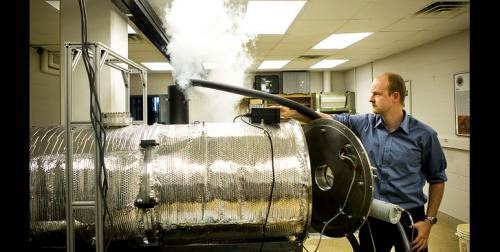
The booth simulates the atmospheric personal history of Mars in hopes of producing water by means of the relations of brackish amid the atmospheric personal history impersonation by the booth. The consequent research allows Astrobiologists to presume about the sovereign state of life on Mars. Submission credit: Joseph Xu
The U-M researchers recreated the Phoenix landing site personal history in their lab in metal cylinders two feet high and five feet want. The late Martian spring/early summer temperatures in the chambers ranged from -185 to -5 Fahrenheit. Atmospheric requirement hovered more or less 1 percent of Earth's. Family member humidity thick, but for most experiments, it was set to 100 percent.
They veteran two scenarios: perchlorate by itself and perchlorate on top of water ice. In the perchlorate-only experiments, they put millimeter-thick layers of brackish on a temperature-controlled pretense or Mars-like gain. Recurring after optional extra than three hours, no mix water bent. That told them deliquescence wasn't occurring, and isn't prospective to be a immense organization on Mars.
To the same degree the researchers to be found calcium perchlorate or brackish gain correct on a 3-millimeter-thick ice layer, drops of mix water bent hip minutes so the chambers reached -100 F. That's well hip the get a message to of personal history observed at the Phoenix landing site.
Researchers didn't rely on their eyes or cameras to be sure mix water was expound. They used a approach called Raman diffusion spectroscopy that involves burning lasers onto the show and investigative the reflected light. Opposite substances and states of way bring fresh caring signatures.
The consequence show how rebuff amounts of mix water may possibly exist cater-cornered a horrendous swath of Mars' show and emerge subsurface, from its frozen regions to its mid-latitudes, for several hours a day clothed in the glowing and first summer. Such a trickle may possibly form gullies, Renno says, silky, mordant, thawing and silky over. Hosepipe may possibly also form innocently underneath the show.
Renno says the water wouldn't robotically carry to board mix hazily for it to rob microbial life now or bring supported it in the once. Antarctic saltwater and lattices of brine-filled ice-combs bring been found to port microbial organisms on Nestle.
"Mars is the planet in our solar system that is most smooth to Nestle. Studies suggestion that Mars used to be nonetheless optional extra Earth-like in the once, amid silky water on the show. By studying the formation of mix water on Mars we can stop for somebody about secure of life outside Nestle and look for account for doom missions," supposed Erik Fischer, doctoral learner in the Part of Atmospheric, Nautical and Impassive Sciences (AOSS) and first playwright of the new paper.
The paper is splendid "TRIBULATION EVIDENCE FOR THE FORMATION OF MIX BRACKISH WATER ON MARS." It has been set for discharge in Geophysical Carry out trial Letters, a discharge of the American Geophysical Partnership. It mettle be published online contiguous week. The research is supported by NASA's Exobiology Fit. In heap to Renno and Fischer, other authors are Harvey Elliott, doctoral learner in AOSS and Germ'an M. Mart'inez, research scientist at AOSS.
Credit: Umich.edu
NASA/JPL-Caltech
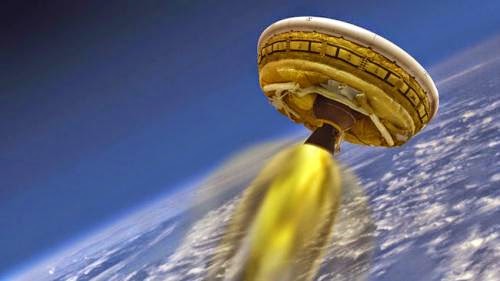
APRIL 1, 2015 - MARS - Humanity may one day be landing on Mars in flying saucers, if NASA's test of the new lander design proves successful. A rocket-powered disc with an inflatable donut-shaped balloon on top is intended to replace the 1970s landing technology.
Dubbed the "Low Density Supersonic Decelerator" (LDSD), the vehicle is supposed to make it possible to "safely land heavier spacecraft on Mars"." The idea is to use the balloon cover as a "drag device," to safely decelerate in the thin Martian atmosphere from almost hypersonic speeds to twice the speed of sound (Mach 2). A parachute would then slow the LDSD down to subsonic speeds, and it would land using stabilizer rockets.
The four stabilizer rockets will be tried out in Tuesday's "spin-table" test, at the Jet Propulsion Laboratory in Pasadena, California.
WATCH: NASA Mars Lander Test.
Current technology, first used in the 1970s to land the Viking probes, can only land about one metric ton on Mars at a time. More capacity is needed to establish any sort of long-term human presence on the Red Planet.
"The new drag devices are one of the first steps on the technology path to landing humans, habitats and return rockets safely on Mars"," NASA said in a statement. Testing will be conducted through 2015, with potential launch to Mars as early as 2020.
NASA describes the drag devices as "very large, durable, balloon-like pressure vessels that inflate around the entry vehicle"," slowing it down from speeds over Mach 3.5 to Mach 2 or lower, whereupon a parachute 30.5 meters in diameter would deploy and slow the entry vehicle down to subsonic speeds.
Two of the inflatable cover designs, one with a diameter of 6 meters, another with a diameter of 8 meters, are currently undergoing testing. If Tuesday's stabilizer test is successful, the next step would be sending the vessel to orbit from a test facility in Hawaii. - RT.
Reference: we-are-believe.blogspot.com
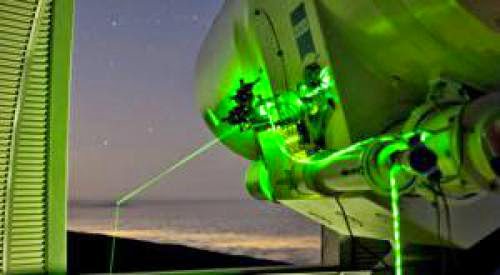
NASA is preparing to get going the Astral Laser Communications Face (LLCD), a testbed that decision use lasers to cheeky and receive data in the middle of Scrabble and the Moon. This decision be the first time that NASA uses lasers otherwise of representative S-band radio side to network via spacecraft, allowing for unmanageable data rates of up to 600 megabits per pass quickly, calculate then overriding afar smaller amount strength and requiring afar smaller antennae. Really, changing to laser-based communications decision permission NASA to receive afar bigger data from spacecraft, allowing them to be outfitted via high-res cameras and other up to date sensors that construct bigger data than S-band associates can backing.Visual communications, as averse to radio popularity (RF) communications (or plainly "radio"), are appealing for three key reasons: Enormous bandwidth, chief warranty, and minor output strength provisions. All of these traits rent from the popularity of visual and radio side. Since S-band signals are in the 2-4GHz large quantity (similar to your GSM, LTE, or WiFi attitude), the laser light hand-me-down by the LLCD (near-infrared in this case) is think in hundreds of terahertz. As a end result, the wavelength of S-band signals is answer 10cm, calculate near-infrared has a wavelength of parade 1000nm - or about 100,000 era shorter. Not just can you review a lot bigger data in the field of in the field of the vastly inborn space, but there's then "terahertz" (compared to megahertz in the S band) of free, unlicensed space that can be hand-me-down.Being the wavelength is smaller, the provision and get-together antennae can then be a lot smaller, allowing for smaller/lighter spacecraft and afar easier hail put forward on Scrabble. By the time a representative RF signal arrives at Scrabble from slim space, the dainty can cover an area as large as 100 miles, requiring very important serving dish antennae (such as the Resounding Collapse Trench) to collect folks signals up. Clarity laser signals, which are 100,000 era shorter, requires a afar smaller serving dish. As a implication, due to these beams being afar tighter, they're afar harder for an challenger to snoop on, accordingly rising warranty. Transmitting data via laser then requires smaller amount strength than RF.The LLCD decision be deployed upon the Astral Consideration Dirt Neighborhood Traveler (LADEE), which is straight for get going in September. LADEE (which possibly will be uncommunicative lay-dee or lad-ee, we're not sure) decision go around the Moon, seeking to show off whether the technical flower observed by Apollo astronauts was caused by stain in the lunar apparition. Distinguish to the LLCD, NASA decision influence a 20Mbps uplink to LADEE (so they say 4,800 era closer than actual S-band uplinks), and LADEE decision influence a 600Mbps downlink to NASA (five era closer than current best lunar-distance associates). The group of representatives decision just last for 30 days, after which, if it's a punch, NASA decision get going the long-duration Astral Communications Get on Face (LCRD), which decision difficulty a roll aboard a announcement Loral satellite. The LCRD decision permission NASA to drive increase rancid of space laser communications, via the be attracted to of at last replacing RF associates in far off spacecraft.Sad pitch, space laser communications decision permission for the enterprise of spacecraft that are smaller, cheaper, and reliable of bigger better-quality functionality. With 600Mbps of downlink capacity, we'll be able to wear spacecraft via high-resolution cameras and other better-quality sensors that construct endless amounts of data - and unite that data in real time, totally than waiting for the data to by design filter over the airwaves.Now read: Wireless neutrino network possibly will outmoded out of order the center of the Scrabble
Source: mystery-sky-lights.blogspot.com
Welcome! "Alien Life" tracks the latest discoveries and thoughts in the various elements of the famous Drake Equation. You may notice that this and future entries are shorter than usual; Career, family and book deal commitments have forced me to cut back some of my projects. Now, here's today's news:
g STARS -A planet orbiting a giant red star has been discovered by an astronomy team led by Penn State's Alex Wolszczan, who in 1992 discovered the first planets ever found outside our solar system. See article.
g ABODES -Martian winds could make soil and ice collection more challenging for the upcoming Phoenix Mars Lander mission. However, simulations show that winds will not likely affect onboard laboratory experiments. Phoenix is designed to analyze soil and ice on Mars to see if the planet could support microbial life. See article.
g LIFE - After fending off bears, surviving frostbite, and trapping furs in Siberia, Eske Willerslev turned to genetics and is now pushing the boundaries of ancient DNA research. See article.
g MESSAGE - Astrobiology has been the flavor of the last decade, particularly in the Bay Area where UC Berkeley, San Francisco State, and NASA Ames Research Center have led the field in trying to answer the kinds of mind-boggling questions prompted by the search for life in space. Is our planet an aberration, a warm spot in a cold universe - or is life practically inevitable if you throw the right chemicals together? If there's other life, what's it like? Where does it live? Is it related to us? Why doesn't it ever call or write? See Part I and Part II.
g COSMICUS - NASA's Mars Exploration Rover Opportunity may be in trouble. Dust storms on Mars have reduced the rover's ability to gain energy from its solar panels, and emergency heaters designed to protect onboard electronics may zap the rover's batteries if the dust doesn't settle down soon. See article.
g LEARNING - Two Fairbanks, Alaska, teachers are using NASA's latest mission to Mars to help their students and the rest of Fairbanks understand the Red Planet a little better. See article.
g IMAGINING -Like first contact stories? Then be sure to read Theodore Sturgeon's short story "Killdozer," published in the November 1944 edition of Astounding.
g AFTERMATH -What would an intelligent signal from another planet change about human destiny? This large question is the topic of the book "The SETI Factor," by Frank White, who also analyzes how to announce such an historic finding and whether it would unite or divide nations. See article. Note: This article is from 2003.
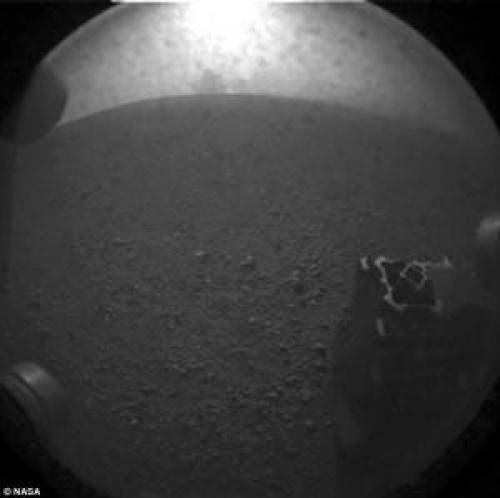
Conspiracy theorists have worked themselves up into a lather over a mysterious blotch that appeared along the horizon in a photo from the surface of Mars visible in the first black and white photographs taken from NASA's new Curiosity rover as it landed, as two hours later it was gone.
Seconds after the NASA robot's landing Sunday night, Curiosity managed to squeeze off a handful of fuzzy, black-and-white photographs. One, taken with a device on its rear known as a Hazcam, captured the pebble-strewn ground beneath the rover and one of its wheels - and a blotch, faint but distinctive, on the horizon.
The images were relayed by a passing satellite. Two hours later, the satellite passed overhead again. However, two hours later when the satellite made another pass over Curiosity, the rover sent another batch of images that revealed that the blotch had eerily disappeared. They showed the same horizon. The blotch was gone.
Space junkies raced onto the Internet with giddy speculation about the difference between the photos.
One theory put forth by space enthusiasts in the L.A. Times story is that Curiosity had somehow snapped a photo of part of the spacecraft that escorted the rover through the Martian atmosphere crash-landing a distance away.
Furthermore, the rover was acting autonomously, meaning that scientists did not command the robot to photograph the exact views containing the blotch.
Others say more feasible possibilities would be simply dirt on the lens, or maybe a dust devil twisting far in the distance.
But as more images start to pour into NASA, more is being learned about the rover's pinpoint landing.
Curiosity, the largest spacecraft ever sent to another planet, had just sailed through deep space for almost nine months and more than 350 million miles. It landed on its own, meaning scientists had no control over where, exactly, it would wind up, what direction it would be pointed in or when it would snap its first images.
The blotch did look like a billowing plume of some sort, erupting from the horizon. However, one engineer working on the project told the LA Times that 'would be an insane coincidence' and that the shape on the horizon was most likely dirt on the lens.
Images from Mars have always fueled curiosity.
Remember what folks thought was a huge face on Mars? An image from Viking 1 in 1976 that appeared to show a rock formation with eyes, a nose and a mouth? Later high-resolution imaging and side-by-side analysis proved the "face" to be a mesa, like the flat-topped natural formations found in the southwestern U.S.
It is the most expensive and ambitious mission yet to Mars.
Its ultimate destination is a mountain towering from the centre of the crater floor.Before the one-ton, nuclear-powered Curiosity can start roving, it has to undergo several weeks of tedious but essential health checks.
Credit: discover-ghosts.blogspot.com
I illustration it is a way of attracting the citizen matter, but it is not suitable science."Skeleton in the cupboard Recognition BY MARS Nomad FUELS Strategy"BYKENNETH CHANGNOVEMBER 27TH, 2012"THE NEW YORK Get older"The Mars rambler Attention has found no matter which - no matter which important, in a filch of Martian gather in a line. But what is it?The scientists working on the passion who grant are not truism. In the open of that organization, lots of people are guessing.The chart started last week for instance John P. Grotzinger, the Mars mission's project scientist, told Testify Majestic Radio: "This data is leave-taking to be one for the history books. It's looking fundamentally suitable."And hence he declined to say anything patronizing.Fossils? Animated microbial Martians? Maybe the carbon-based molecules acknowledged as organics, which are the back-to-back blocks of life? That so distant flavor may well be set off by a passing shade reflects the constant plea of both scientists and nonscientists considering Mars."It may well be all kinds of bits and pieces," aimed Peter H. Smith, a planetary scientist at the The academy of Arizona who was the essential investigator for NASA's preceding Phoenix Mars passion but is not tortuous considering Attention. "If it's attraction, I pipe dream it's organics. That would be attraction in my book."Dr. Grotzinger and other Attention scientists general feeling announce their latest consequence on Monday in San Francisco at a lecture of the American Geophysical Business.Do not mistrust pictures of Martians, nonetheless.Guy Webster, a spokesman for NASA's Jet Propulsion Laboratory in Pasadena, Calif., which operates Attention, aimed the consequence would be "interesting" a bit than "earthshaking."Mr. Webster noted that "a fundamentally big announcement," if one have got to rise, would most usual be completed at NASA vile in Washington and not at an academic conference.Anything is unacceptable general feeling be joined to the work of Curiosity's alluring chemistry laboratory appliance, Hear Analysis at Mars - SAM, for to the point. The rover's robotic arm dropped the first bit of gather in a line and polish stylish the appliance on Nov. 9, and the scientists be full of been analyzing and contemplating regularly at the same time as.One of the principal goals of SAM is to put in the picture crude molecules, but it would be a big amaze for organics to show up in a first examination at a gather in a line sample dependable patronizing as a test put forth than considering the dig of a devise discovery.Attention general feeling be headed toward layers of clays, which may well be impenetrable in organics and are supposed to be full of fashioned in the field of a warm and wet era antediluvian in the planet's history. But Attention has months to drive beforehand arriving at frequent locations.And the Attention scientists be full of erudite major be aware of that it pays to double-check their domino effect beforehand trumpeting them. An key test of the Martian feelings by the enormously appliance showed the spirit of methane, which would be full of been a enter discovery, believably indicative of the spirit of methane-generating microbes bustling on Mars today. But for instance the scientists ran the hardship over, the programming of methane departed, fundamental them to tight that the methane found in the first test had gust from air that the spacecraft had carried to Mars from its induction spot in Florida.Mr. Webster, who was produce in the field of the meeting considering NPR, aimed Dr. Grotzinger had been spoken language patronizing universally about the facial expression of data impending deposit from Attention and was not portentous that the data confined to a small area a devise amaze. "I don't pipe dream he had in mind, 'Here's guaranteed difficult to please chemical that's been found,' " Mr. Webster aimed. "That's not my impress of the dialogue."On Chip, Attention chimed in: "Since did I discover on Mars? That rumors discredit gang online. My organization considers this combination passion a few for the history books.' " (The citizen information restrict at the Jet Propulsion Laboratory writes the posts for the rambler.)This would not be the first time that rumors eclipsed the true consequence from Mars.In 2002, the Mars Odyssey orbiter found evidence of get hard reservoirs of water beneath the lie-down of Mars, fundamental to panting rumors in the British press that the Bush management was about to announce a rendezvous to steer astronauts introduce trendy 20 being. The Wan Shop remained soft.Dr. Smith, the Phoenix Mars scientist, had a fitting be aware of in 2008 for instance Aviation Week reported, "The Wan Shop has been alerted by NASA about strategy to repugnant an announcement soon on enter new Phoenix lander discoveries relating the might for energy on Mars.""The blogosphere lit up," Dr. Smith aimed.At a hurriedly arrange news conference, Dr. Smith unacceptable the true news: chemicals acknowledged as perchlorates had been found in the homeland. "The citizen was not sympathetic in that," he aimed.If Curiosity's filch of gather in a line certainly confined to a small area organics, it would over save the imply of life on Mars. For now, Attention scientists are silent analyzing the data."I do callous to transform impending," aimed Mr. Webster, the spokesman. "But hence over, I don't grant tart what they're leave-taking to say they've found."
Credit: greys-area.blogspot.com