NASA's Lunar Atmosphere and Dust Environment Explorer (LADEE) spacecraft continues to operate in the lunar commissioning orbit at approximately 155 miles (250 kilometers) above the surface of the moon. The orbit is not perfectly circular because of the moon's lumpy gravity field. In this orbit, the Mission Operations Team at NASA's Ames Research Center, Moffett Field, Calif., are testing and calibrating the three science instruments, as well performing the primary Lunar Laser Communication Demonstration (LLCD) experiments. LADEE now is at the half-way point in the commissioning, with the first two blocks of science commissioning activities and the first two blocks of LLCD experiments complete. During the LLCD experiment blocks, the LLCD team demonstrated all-optical acquisition data transfers (without depending on any help from the radio system) at 10 and 20 megabits per second (Mbps) uplink, and transfers at 155, 311, and 622 Mbps downlink. These downlink rates are higher than typical home internet streaming video. All optical contact attempts with the U.S. ground stations at White Sands in New Mexico and Table Mountain in California have been successful. Later in the experiment, the LLCD team was able to demonstrate the ability to operate through thin clouds, as well as handing off from one ground station to another. This is significant because such a capability will be required for future operational use. The LLCD team also has started contact passes with a European ground station in Tenerife, Spain. The science instrument commissioning activities also have been going well, with all three instruments taking calibration data. The Neutral Mass Spectrometer (NMS) completed a variety of tests, including its first measurements of atoms and molecules in the lunar atmospheric. The NMS instrument has operated while pointing in many directions to look for atoms and molecules from a variety of sources. The Ultraviolet-Visible Spectrometer (UVS) completed its initial calibrations, including verifying the precise pointing direction of its telescope and solar viewer. The UVS instrument also has peered over the lunar horizon to look for the glow of atoms, molecules and dust in the lunar atmosphere. The Lunar Dust Experiment (LDEX) has been performing a high-altitude dust survey before dropping to the lower science orbit later this month. The science instrument commissioning and LLCD primary experiment will be conducted through mid-November, after which the spacecraft will drop down to the lower lunar science orbit and start the full science phase of the mission. Posted by: Soderman/SSERVI StaffSource: NASA ARC/Butler Hine
Scientists using the LYMAN ALPHA MAPPING PROJECT (LAMP) spectrometer aboard NASA's LUNAR RECONNAISSANCE ORBITER (LRO) have made THE FIRST SPECTROSCOPIC OBSERVATIONS of the noble gas helium in the tenuous atmosphere surrounding the moon, notes NASA.
NASA's LRO orbiting the moon
NASA'S LRO conducted the remote sensing observations complimenting the first evidence gathered indicating helium on the moon. The data were in-situ measurements taken by the Lunar Atmospheric Composition Experiment (LACE) by the "APOLLO 17", the last human mission to the lunar surface in 1972.
The lunar scientists (selenologists) gained the ultraviolet emissions visible in the tenuous atmosphere above the lunar surface, detecting helium over a campaign spanning more than 50 orbits of the LRO.
"THE QUESTION NOW BECOMES, DOES THE HELIUM ORIGINATE FROM INSIDE THE MOON, FOR EXAMPLE, DUE TO RADIOACTIVE DECAY IN ROCKS, OR FROM AN EXTERIOR SOURCE, SUCH AS THE SOLAR WIND?" says Dr. Alan Stern, LAMP principal investigator and associate vice president of the Space Science and Engineering Division at Southwest Research Institute, Boulder, Colo.
"IF WE FIND THE SOLAR WIND IS RESPONSIBLE, THAT WILL TEACH US A LOT ABOUT HOW THE SAME PROCESS WORKS IN OTHER AIRLESS BODIES," says Stern.
If spacecraft observations show no such correlation, radioactive decay or other internal lunar processes could be producing helium that diffuses from the interior or that is released during lunar quakes.
NASA's LADEE in 2013
The next US moon mission, the" LUNAR ATMOSPHERE AND DUST ENVIRONMENT EXPLORER" (LADEE), is set for launch from Wallops Island, Virginia in THE SUMMER OF 2013 on a planned 100-day mission in lunar orbit. Orbital Sciences Corp. will utlize the Minotaur V launch vehicle to lift LADEE into space and carry two major scientific experiments to provide better understand of lunar dust in the moon's atmosphere.
THE LUNAR DUST EXPERIMENT (LDEX) instrument led by Mihaly Horanyi at the Laboratory for Atmospheric and Space Physics, University of Colorado, Boulder, Colo. and the UltraViolet Spectrometer (UVS), led by Tony Colaprete at NASA Ames, will provide scientists with more extensive lunar atmospheric analysis.
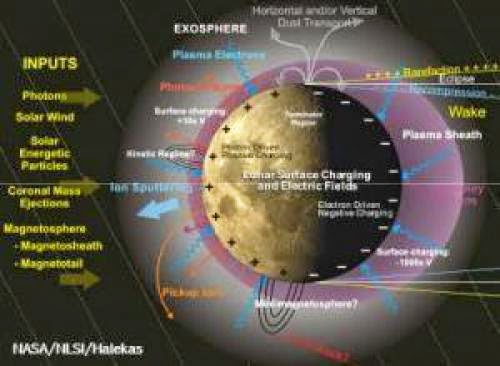
The instruments will detect and constrain the abundances of species expected to be prevalent at the 50 km altitude, due to the solar wind and its interactions with the surface, release from regolith, and radiogenic sources. The NMS is a quadrupole mass spectrometer designed ot detect species up to 150 amu and will look for CH4, S, O, Si, Kr, Xe, Fe, Al, Ti, Mg, OH, and H2O. The UV/Vis will detect Al, Ca, Fe, K, Li, Na, Si, T, Ba, Mg, H2O, and O and will monitor the dust composition.