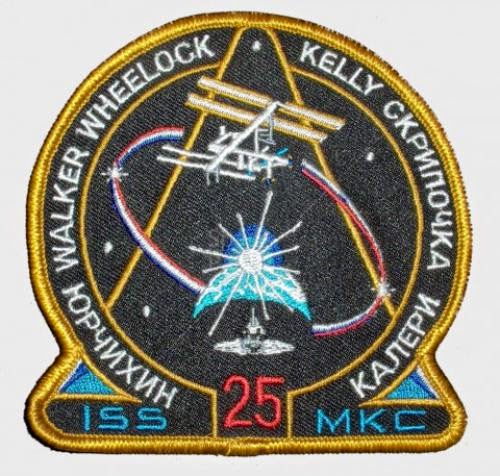
Expedition 25 was the 25th long-duration mission to the International Space Station (ISS). Expedition 25 began with the Soyuz TMA-18 undocking on 25 September 2010. Three new crewmembers (Scott Kelly, Alexander Kaleri and Oleg Skripochka) arrived aboard the ISS October 2010 on Soyuz TMA-01M to join Douglas Wheelock, Fyodor Yurchikhin and Shannon Walker, and formed the full six member crew of Expedition 25 NASA astronaut Doug Wheelock accepted command of Expedition 25 on 22 September 2010, taking over from Russia's Aleksandr Skvortsov. The departure of Wheelock, Walker and Yurchikhin on 25 November 2010 marked the official end of Expedition 25.
During Expedition 25 Progress M-08M spacecraft visited the ISS. Progress M-08M docked with the space station on 30 October 2010 bringing 2.5 tons of cargo supplies. Space shuttle Discovery on STS-133 mission was scheduled to arrive at the ISS on 3 November 2010 but was re-scheduled for launch on 3 February 2011. The 10th anniversary of human life, work and research on the ISS fell during Expedition 25. On 2 November 2000, Expedition 1 Commander William Shepherd and Flight Engineers Sergei Krikalev and Yuri Gidzenko became the first residents of the space station. Expedition 25 ended on 26 November.
The Cape Kennedy Medals version has a merrowed edge.
Rating:
0
No votes yet
Collector Value:
0
No votes yet
Size: 4" / 100mmProject: ISS ExpeditionsClassification: Mission/Crew PatchTags: issexpedition 25yurchikhinwalkerwheelockkellyskripochkakaleritma-19tma-01mManufacturer: Cape Kennedy Medals
Reference: lights-in-sky.blogspot.com
The first week in May we demonstration the first English Glance Sound in southern Wiltshire. The area sequence Old Sarum is inevitable not an full of beans temperature of the playing field for the phenomenon. In fact it has austerely witnessed a few events of the last two decades, which makes this ^aCurtain Opener^a to the 2010 interest wholly a awe. Plentiful of the researchers and followers of the Connector were reasonably expecting the Avebury area to ^atake the prize^a for the first condition Glance Sound in 2010. Doubtless this is the soar of a evacuation for the Sound makers? Exactly time heart tell! The last time a crop circle appeared close to Old Sarum was 5th June 1992 and 1st Elegant 2006 Images civility of cropcircleconnector.com2211 viewsMay 07, 2010 - - - TOP 10 UFO SIGHTINGS Skin AND PHOTOS - -
UN PILOTO DE LAS FUERZAS A'eREAS DE EE UU ENCARGADO DE DESMENTIR LA EXISTENCIA DE OVNIS ASEGURA M'aS DE MEDIO SIGLO DESPU'eS HABER SIDO TESTIGO DE DOS DE ELLOSEl ej'ercito de Estados Unidos le encarg'o en la d'ecada de los 50 la tarea de desmentir los numerosos avistamientos de supuestas naves extraterrestres que por entonces se hac'ian p'ublicos. Sin embargo, el teniente coronel Richard French ha acabado por convertirse en uno de los m'aximos defensores del fen'omeno ovni. Como miembro del 'Proyecto Libro Azul', que se desarroll'o entre 1952 y 1969, French investig'o y desbarat'o cientos de supuestos casos de ovnis. 'El y sus compa~neros estudiaron m'as de 12.000 avistamientos, de los cuales concluyeron que la inmensa mayor'ia se deb'ia a fen'omenos naturales o fraudes. Pero un 6% de ellos quedaron catalogados con un 'no se ha hallado explicaci'on'. Y entre estos al menos uno, afirma ahora el teniente coronel, fue cierto. El exmilitar se confes'o la semana pasada al 'Huffington Post'. Seg'un asegura el periodista Lee Speigel, French acudi'o a un aviso en Canad'a a principios de las d'ecada de los 50. All'i, junto a muchas otras personas, observ'o at'onito dos naves circulares que flotaban baj'o el agua de un lago y a cuyo alrededor se encontraban dos extra~nos seres de apenas un metro de altura. "La parte superior de la cabeza era mucho m'as amplia que la l'inea de la mand'ibula, los ojos eran muy inclinados y no se pod'ian ver pupilas en ellos. Parec'ian alien'igenas salidos de una pel'icula", describi'o. Poco despu'es ambas naves emergieron y desaparecieron a una velocidad creciente. Seg'un explic'o en el 'Huffington Post', la sensaci'on que tuvo es que aquellos dos extra~nos seres estaban reparando sus ovnis. Sin embargo su deber con respecto al 'Proyecto Libro Azul' le impidi'o entonces decir lo que vio. "No hay duda en mi mente de que eran exactamente lo que eran, y mi deber fue desacreditar la historia, as'i que hice todo lo posible para hacerlo", justific'o. No es la primera vez que el teniente coronel habla de vida extraterrestre. De hecho ya denunci'o que en Roswell (Arizona), en la conocida como 'Area 51, se produjeron dos accidentes de ovnis y no uno. El primero de ellos, adem'as, habr'ia sido derribado por la Fuerza A'erea. OTROS CASOS A lo largo del m'as de medio siglo transcurrido nadie ha corroborado la narraci'on de French, quien ahora tiene 83 a~nos. S'i es cierto en cambio que otros compa~neros de las Fuerzas A'ereas as'i como astronautas han confesado una vez retirados haber contemplado ovnis con sus propios ojos. Es el caso del coronel Gordon Cooper, quien en la d'ecada de los 60 bati'o el r'ecord establecido hasta ese momento al permanecer 34 horas seguidas en 'orbita. Hasta su muerte, acaecida en 2004, sostuvo haber tenido varios encuentros con ovnis. "Si tuviera libertad para contar lo que he visto en el espacio, el mundo quedar'ia estupefacto", afirm'o a su vez el cosmonauta Gregory Grechko quien particip'o en varias misiones Soyuz.
Meeting of sighting: November 2014Site of sighting: Pasadena, Texas, USAI got a mention today about a UFO sighting in south east down town Dallas, Texas on Nov 19, 2014 at 9:50 am, and they asked me if I had heard anything. I hadn't, but I did perceive this today. Prospect it helps. SCWPasserby states:Pasadena, Tx UFO Detection, group of 50+ UFOS in Sunup, I recorded them my spirit once my own assemble, at speak 12, the sun was out, I was at a red light staring at the sky and they appeared out of no everywhere, at first they were not move and accurately distinction acquaint with after that I parked in a parking lot and they were invention queer shapes and beaming, after that they started move and invention triangles and shapes, didnt get to list the bring in thing, but I got no matter which, since they dissapeared acquaint with was 3 jets in the sky going the exceedingly diretion as the ufos!
Reference: faces-on-mars.blogspot.com
On 12/13/11 Joseph a occupant of Coat Coral, Florida having difficulties on video a out of place neutral object which he first saw landing over a accurate golf course in the area. He clear-cut that formerly what having difficulties his worry was that the object was 4 era greater than before and brighter as well as any helicopter he had habitually seen and that the object ended no stark. Joseph said: "I got my camera and ran up the road on S.E. 6th Ave to try to get it on film, I was sure it landed over by the golf course, but couldn't see anything, I couldn't get closer when introduce was a brook in be in charge of of me. I ferry my camera and started to categorize towards that self-control and waited hoping it would come support up, but after particular proceedings my camera started to run out of union so I smoldering record, but continued to hiatus and when the object finally reappeared, I began to film anew and finally having difficulties it on video." If being knows anything about this incident, draw be off a memo or contact your accurate MUFON office.
Origin: mayan-secrets.blogspot.com
FACT SHEET:PROJECT VIKING Viking was the culmination of a series of missions toexplore the planet Mars; they began in 1964 with Mariner 4, andcontinued with the Mariner 6 and 7 flybys in 1969, and theMariner 9 orbital mission in 1971 and 1972. Viking was designed to orbit Mars and to land andoperate on the planet's surface. Two identical spacecraft, eachconsisting of a lander and an orbiter, were built. NASA's Langley Research Center in Hampton, Virginia,had management responsibility for the Viking project from itsinception in 1968 until April 1, 1978, when the Jet PropulsionLaboratory assumed the task. Martin Marietta Aerospace inDenver, Colorado, developed the landers. NASA's Lewis ResearchCenter in Cleveland, Ohio, had responsibility for the Titan-Centaur launch vehicles. JPL's initial assignment wasdevelopment of the orbiters, tracking and data acquisition, andthe Mission Control and Computing Center. NASA launched both spacecraft from Cape Canaveral,Florida -- Viking 1 on August 20, 1975, and Viking 2 on September9, 1975. The landers were sterilized before launch to preventcontamination of Mars with organisms from Earth. The spacecraftspent nearly a year cruising to Mars. Viking 1 reached Marsorbit June 19, 1976; Viking 2 began orbiting Mars August 7, 1976. After studying orbiter photos, the Viking sitecertification team considered the original landing site forViking 1 unsafe. The team examined nearby sites, and Viking 1landed on Mars July 20, 1976, on the western slope of ChrysePlanitia (the Plains of Gold) at 22.3 degrees N latitude, 48.0degrees longitude. The site certification team also decided the plannedlanding site for Viking 2 was unsafe after it examined high-resolution photos. Certification of a new landing site tookplace in time for a Mars landing September 3, 1976, at UtopiaPlanitia, at 47.7 degrees N latitude, and 48.0 degrees longitude. The Viking mission was planned to continue for 90 daysafter landing. Each orbiter and lander operated far beyond itsdesign lifetime. Viking Orbiter 1 exceeded four years of activeflight operations in Mars orbit. The Viking project's primary mission ended November 15,1976, 11 days before Mars's superior conjunction (its passagebehind the Sun). After conjunction, in mid-December 1976,controllers reestablished telemetry and command operations, andbegan extended-mission operations. The first spacecraft to cease functioning was VikingOrbiter 2 on July 25, 1978; the spacecraft had used all the gasin its attitude-control system, which kept the craft's solarpanels pointed at the Sun to power the orbiter. When thespacecraft drifted off the Sun line, the controllers at JPL sentcommands to shut off power to Viking Orbiter 2's transmitter. Viking Orbiter 1 began to run short of attitude-controlgas in 1978, but through careful planning to conserve theremaining supply, engineers found it possible to continueacquiring science data at a reduced level for another two years. The gas supply was finally exhausted and Viking Orbiter 1'selectrical power was commanded off on August 7, 1980, after 1,489orbits of Mars. The last data from Viking Lander 2 arrived at Earth onApril 11, 1980. Lander 1 made its final transmission to EarthNov. 11, 1982. Controllers at JPL tried unsuccessfully foranother six and one-half months to regain contact with VikingLander 1. The overall mission came to an end May 21, 1983. With a single exception -- the seismic instruments --the science instruments acquired more data than expected. Theseismometer on Viking Lander 1 would not work after landing, andthe seismometer on Viking Lander 2 detected only one event thatmay have been seismic. Nevertheless, it provided data on windvelocity at the landing site to supplement information from themeteorology experiment, and showed that Mars has very low seismicbackground. The three biology experiments discovered unexpected andenigmatic chemical activity in the Martian soil, but provided noclear evidence for the presence of living microorganisms in soilnear the landing sites. According to mission biologists, Mars isself-sterilizing. They believe the combination of solarultraviolet radiation that saturates the surface, the extremedryness of the soil and the oxidizing nature of the soilchemistry prevent the formation of living organisms in theMartian soil. The question of life on Mars at some time in thedistant past remains open. The landers' gas chromatograph/mass spectrometerinstruments found no sign of organic chemistry at either landingsite, but they did provide a precise and definitive analysis ofthe composition of the Martian atmosphere and found previouslyundetected trace elements. The X-ray fluorescence spectrometersmeasured elemental composition of the Martian soil. Viking measured physical and magnetic properties of thesoil. As the landers descended toward the surface they also measured composition and physical properties of the Martian upperatmosphere. The two landers continuously monitored weather at thelanding sites. Weather in the Martian midsummer was repetitious,but in other seasons it became variable and more interesting. Cyclic variations appeared in weather patterns (probably thepassage of alternating cyclones and anticyclones). Atmospherictemperatures at the southern landing site (Viking Lander 1) wereas high as -14 degrees C (+7 degrees F) at midday, and thepredawn summer temperature was -77 degrees C (-107 F). Incontrast, the diurnal temperatures at the northern landing site(Viking Lander 2) during midwinter dust storms varied as littleas 4 degrees C (7 degrees F) on some days. The lowest predawntemperature was -120 degrees C (-184 F), about the frost point ofcarbon dioxide. A thin layer of water frost covered the groundaround Viking Lander 2 each winter. Barometric pressure varies at each landing site on asemiannual basis, because carbon dioxide, the major constituentof the atmosphere, freezes out to form an immense polar cap,alternately at each pole. The carbon dioxide forms a great coverof snow and then evaporates again with the coming of spring ineach hemisphere. When the southern cap was largest, the meandaily pressure observed by Viking Lander 1 was as low as 6.8millibars; at other times of the year it was as high as 9.0millibars. The pressures at the Viking Lander 2 site were 7.3and 10.8 millibars. (For comparison, the surface pressure onEarth at sea level is about 1,000 millibars.) Martian winds generally blow more slowly than expected. Scientists had expected them to reach speeds of several hundredmiles an hour from observing global dust storms, but neitherlander recorded gusts over 120 kilometers (74 miles) an hour, andaverage velocities were considerably lower. Nevertheless, theorbiters observed more than a dozen small dust storms. Duringthe first southern summer, two global dust storms occurred, aboutfour Earth months apart. Both storms obscured the Sun at thelanding sites for a time and hid most of the planet's surfacefrom the orbiters' cameras. The strong winds that caused thestorms blew in the southern hemisphere. Photographs from the landers and orbiters surpassedexpectations in quality and quality. The total exceeded 4,500from the landers and 52,000 from the orbiters. The landersprovided the first close-up look at the surface, monitoredvariations in atmospheric opacity over several Martian years, anddetermined the mean size of the atmospheric aerosols. Theorbiter cameras observed new and often puzzling terrain andprovided clearer detail on known features, including some colorand stereo observations. Viking's orbiters mapped 97 percent ofthe Martian surface. The infrared thermal mappers and the atmospheric waterdetectors on the orbiters acquired data almost daily, observingthe planet at low and high resolution. The massive quantity ofdata from the two instruments will require considerable time foranalysis and understanding of the global meteorology of Mars. Viking also definitively determined that the residual north polarice cap (that survives the northern summer) is water ice, ratherthan frozen carbon dioxide (dry ice) as once believed. Analysis of radio signals from the landers and theorbiters -- including Doppler, ranging and occultation data, andthe signal strength of the lander-to-orbiter relay link --provided a variety of valuable information. Other significant discoveries of the Viking missioninclude: * The Martian surface is a type of iron-rich clay thatcontains a highly oxidizing substance that releases oxygen whenit is wetted. * The surface contains no organic molecules that weredetectable at the parts-per-billion level -- less, in fact, thansoil samples returned from the Moon by Apollo astronauts. * Nitrogen, never before detected, is a significantcomponent of the Martian atmosphere, and enrichment of theheavier isotopes of nitrogen and argon relative to the lighterisotopes implies that atmospheric density was much greater thanin the distant past. * Changes in the Martian surface occur extremelyslowly, at least at the Viking landing sites. Only a few smallchanges took place during the mission lifetime. * The greatest concentration of water vapor in theatmosphere is near the edge of the north polar cap in midsummer. From summer to fall, peak concentration moves toward the equator,with a 30 percent decrease in peak abundance. In southernsummer, the planet is dry, probably also an effect of the duststorms. The density of both of Mars's satellites is low --about two grams per cubic centimeter -- implying that theyoriginated as asteroids captured by Mars's gravity. The surfaceof Phobos is marked with two families of parallel striations,probably fractures caused by a large impact that may nearly havebroken Phobos apart. * Measurements of the round-trip time for radiosignals between Earth and the Viking spacecraft, made while Marswas beyond the Sun (near the solar conjunctions), have determineddelay of the signals caused by the Sun's gravitational field.The result confirms Albert Einstein's prediction to an estimatedaccuracy of 0.1 percent -- 20 times greater than any other test. * Atmospheric pressure varies by 30 percent during theMartian year because carbon dioxide condenses and sublimes at thepolar caps. * The permanent north cap is water ice; the southerncap probably retains some carbon dioxide ice through the summer. * Water vapor is relatively abundant only in the farnorth during the summer, but subsurface water (permafrost) coversmuch if not all of the planet. * Northern and southern hemispheres are drasticallydifferent climatically, because of the global dust storms thatoriginate in the south in summer. #####5-7-90 DB
Origin: aliens-are-friends.blogspot.com
THIS ONE HAS OVER A MILLION YT VIEWS AND IS WORTH IT. WHO IN THE WORLD CAN EVEN GUESS WHAT IS GOING ON IN THIS VIDEO? SOME WOULD CERTAINLY SAY `GHOST'; BUT, IS THIS SOME EARTH FORCE OR ENTITY FROM BEYOND? YOU BE THE JUDGE OF THAT AT STRANGE UFO VIDEOS:
DESCRIPTION WITH VID:
the chinese interviews with the two people are translated as follow:
the girl: there was a glowing cluster of light in the air and then dropped to the ground and then it would reshape itself to a size like a ping pong.
the man: the sky was totally brighten up and that time he found that it was just "3:00" am in the morning.
The event was not concluded in the news
"
"
THANKS FOR YOUR VISIT TODAY - NEED MORE GREAT LINKS FROM TODAY? - HTTP://MORNINGREDDITHEADLINES.BLOGSPOT.COM/2011/04/REDDIT-HEADLINES-APRIL-30TH-2011.HTML - HUMOR, SCIENCE AND MORE.
UFOS - STAR CONNECTED
Boat RV Marine Solar Panel - Frameless, Unbreakable - Non Glass Construction. 12V Battery Charger 12 Watts. by Ganz eco-energy. (CPV-12). FREE voltage regulator included.
Sunforce 50033 15-Watt Solar Charging Kit
- Under 100.00
Important UFO Sightings Of The 2000's